No results. Is a plant missing? Tell uscontact@wikiplant.net
Anubias
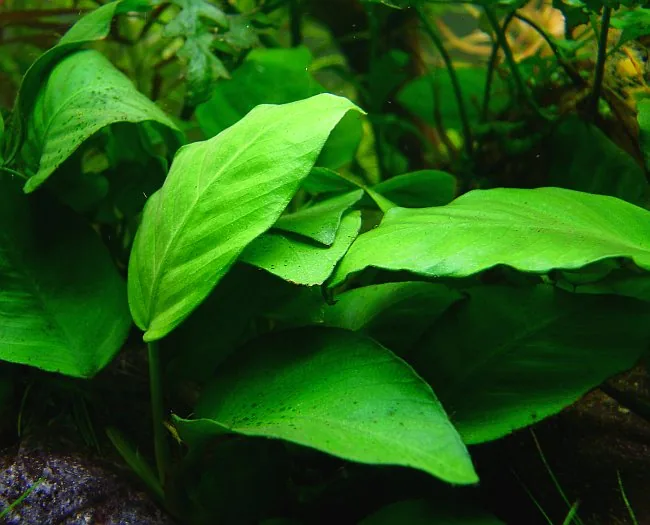
Anubias barteri
Care level: Easy
Anubias barteri grows along the banks of shaded West African streams and rivers, often partly emersed with its thick, waxy leaves poking above the waterline during the dry season. That leaf toughness is why it is one of the very few aquarium plants that also survives being nibbled by herbivorous fish like goldfish or African cichlids.
Low light tolerant (~10-20 PAR); too much light combined with poor flow tends to encourage algae on its slow-growing leaves.
Water
Weekly 20-30% water changes; very adaptable, pH 6.0-7.8, 22-28°C, soft to hard water.
CO2 & Feeding
Does not need injected CO2 and grows fine without it, though light liquid fertilization supports leaf size and color.
Substrate
No substrate needed for the rhizome, tie or glue to driftwood or rock; only the fine roots should be in contact with substrate or hardscape crevices.
Temperature
22-28°C.
Growth speed
Slow
Tank Placement
Attached to hardscape
Common mistake
Planting the rhizome into the substrate is the single most common cause of failure, like Java Fern, the rhizome must stay exposed and only the thin roots below it should touch or enter the substrate.
Care by Season
Spring
Good season to divide a large rhizome into sections once it has several leaf fans.
Summer
Wipe dust and algae film off the tough leaves periodically since slow growth means old leaves stay put for a long time.
Autumn
Growth is already slow so little changes; keep an eye on algae buildup on older leaves.
Winter
Stable temperatures matter more than light levels; avoid cold drafts near the tank.
Growing & Maintenance
Planting
Tie or glue the rhizome to driftwood or rock. Never bury it: only the fine roots may reach the substrate.
Fertilising
A light dose of liquid fertiliser supports leaf size. It needs no injected CO2.
Trimming
Cut off damaged or algae-covered leaves close to the rhizome.
Propagation
By dividing a large rhizome into sections once it has several leaf fans.
Pests & Diseases
Common problems
Soft, rotting rhizome
Most likely cause: The rhizome was buried in the substrate.
What to do: Trim the affected sections and fix the rhizome to wood or rock.
Hard green spots on the leaves
Most likely cause: Green spot algae, from too much light on slow-growing leaves.
What to do: Scrape the spots off and reduce the light.
Algae film on the older leaves
Most likely cause: Strong light combined with poor water flow.
What to do: Wipe the leaves, lower the light and improve the flow.
Only a leaf or two a month
Most likely cause: Normal. It is one of the slowest aquarium plants.
What to do: Nothing to do. Be patient.
Growth stalling
Most likely cause: Unstable temperatures.
What to do: Keep the temperature stable and the tank away from cold draughts.
Pests & Diseases
Green spot algae
Signs: Small hard green dots scattered across the leaf surface
Treatment: Scrape off with a fingernail or soft cloth, reduce light intensity or duration, and check phosphate levels.
Rhizome rot
Signs: Soft, blackened rhizome tissue near where it contacts substrate
Treatment: Trim affected sections and re-secure the rhizome above the substrate with better water circulation.
FAQ
Why does my Anubias grow so slowly?
Anubias is naturally one of the slowest-growing aquarium plants, often producing only a leaf or two per month even under good conditions, this is normal, not a sign of a problem.
Can Anubias grow emersed, out of the water?
Yes, in paludariums or with leaves left above the waterline it grows happily emersed, which is actually closer to its natural habitat than fully submerged growth.
Does Anubias need CO2?
No. It grows fine without injected CO2, and a light dose of liquid fertiliser is enough.
How much light does Anubias need?
Very little. It tolerates low light, and strong light mostly brings algae on its slow-growing leaves.
How do I attach Anubias to wood or rock?
Tie it on with thread or fix it with aquarium-safe glue. The roots then grip the surface themselves.
How do I propagate Anubias?
By dividing the rhizome. Cut a large rhizome into sections once each piece has several leaves.