No results. Is a plant missing? Tell uscontact@wikiplant.net
Brazilian micro sword
Lilaeopsis brasiliensis
Care level: Easy
The Brazilian micro sword is a small, grass-like plant from South America, used to make a lawn across the front of an aquarium. Its narrow, bright green, blade-shaped leaves stand 4-7cm tall and rise in small tufts from a creeping runner just under the surface of the substrate. It is not a true grass but a relative of carrot and parsley. It is undemanding and survives in modest light, but it grows slowly and only knits into a dense carpet when the light is strong.
Tolerates low light, but needs strong light reaching the bottom to form a dense carpet.
Water
Soft to hard freshwater. Added CO2 is helpful but not essential, and it also tolerates slightly brackish water.
CO2 & Feeding
Not applicable; this is grown submerged, or on wet substrate in a paludarium.
Substrate
A fine sand or fine-grained, nutrient-rich aquarium soil that the runners can creep through.
Size
4-7cm tall; spreads by runners into a lawn.
Growth speed
Slow
Tank Placement
Foreground
Did you know?
A lawn takes patience and light. In low light the plant stays alive but sends out few runners, so the tufts stay separate for months. Plant it in many small portions a few centimetres apart and give it strong light, and the gaps close much sooner.
Care by Season
Spring
Growth is slow and steady all year in a heated, lit tank.
Summer
Runners spread fastest under long, bright light. Remove algae-covered leaves.
Autumn
Replant tufts into any gaps.
Winter
No rest period. Keep light and nutrients steady.
Growing & Maintenance
Planting
Split the pot into small tufts and plant them a few centimetres apart with tweezers, in fine substrate, with the runner just covered.
Fertilising
Use a nutrient-rich soil or push root tablets into sand near the plants, and add a complete liquid fertiliser.
Trimming
Remove old or algae-covered leaves at the base. Thin a very dense carpet so light and water reach the lower parts.
Propagation
By runners: lift a section, cut the runner into pieces that each carry a few tufts and replant them.
Pests & Diseases
Common problems
The tufts do not join up
Most likely cause: Too little light or nutrients.
What to do: Increase the light and feed the roots.
Leaves yellow or pale
Most likely cause: A nutrient shortage in plain sand or gravel.
What to do: Add root tablets and liquid fertiliser.
Leaves covered in algae
Most likely cause: Slow growth under strong light.
What to do: Remove affected leaves and rebalance light and nutrients.
New plants melt back
Most likely cause: The change from emersed to submerged growth.
What to do: Remove decaying leaves and wait; new leaves grow from the runner.
Tufts keep floating up
Most likely cause: Planted too shallow or in coarse gravel.
What to do: Replant deeper in fine substrate.
Pests & Diseases
Algae on the leaves
Signs: Green film, threads or dark tufts on the slow-growing leaves, mostly in strong light with few other plants.
Treatment: Cut out the worst leaves, shorten the light period, grow fast plants alongside and add algae-eating shrimp or snails.
Uprooting by fish
Signs: Tufts floating at the surface in a newly planted tank.
Treatment: Plant deeper in fine substrate and add digging fish only once the plant has rooted.
FAQ
Does it need CO2?
Not to survive. Added CO2 and a nutrient-rich substrate speed up its slow growth and help it form a dense carpet.
How do I plant it?
Divide the pot into small tufts and plant them a few centimetres apart with tweezers, burying the runner and roots but leaving the leaves free. Planting many small pieces covers the ground far faster than a few large ones.
Why is my micro sword not spreading?
Too little light is the usual reason, followed by a poor substrate. Check that nothing shades it, and add root fertiliser or a nutrient-rich soil.
How do I keep algae out of the lawn?
Slow-growing leaves near the bottom collect algae easily. Keep the light period moderate, grow fast stem plants alongside to take up surplus nutrients, and add algae-eating shrimp or snails.
Do I need to trim it?
Rarely. The leaves stop at a few centimetres. Cut out old, algae-covered leaves near the base and thin the carpet if it grows very dense.
Can it grow in a paludarium or out of water?
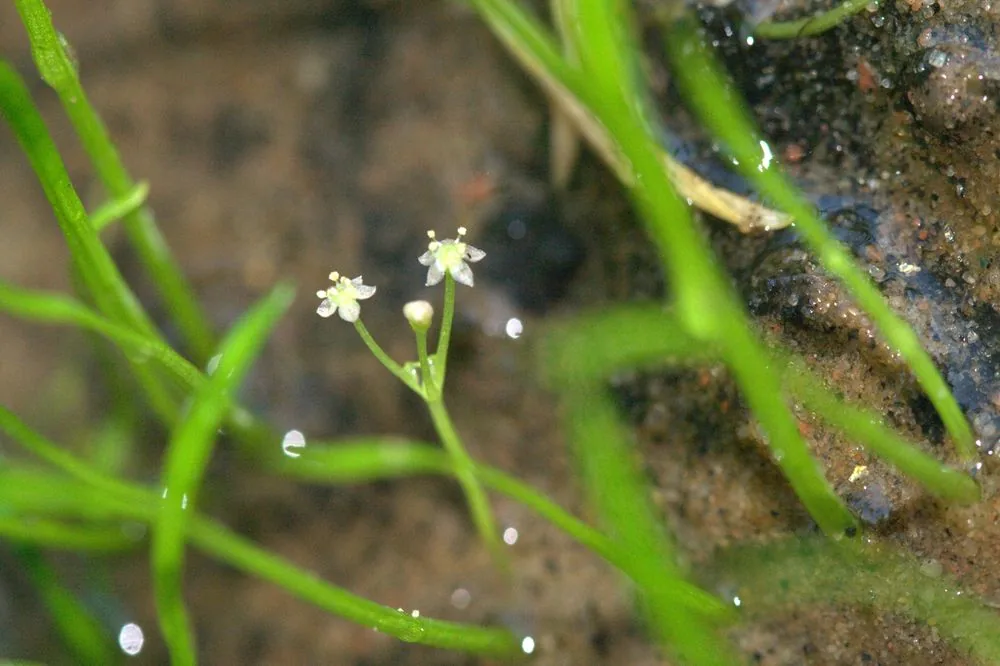
Yes. On permanently wet substrate it grows as a short marsh plant and can carry tiny white flowers.