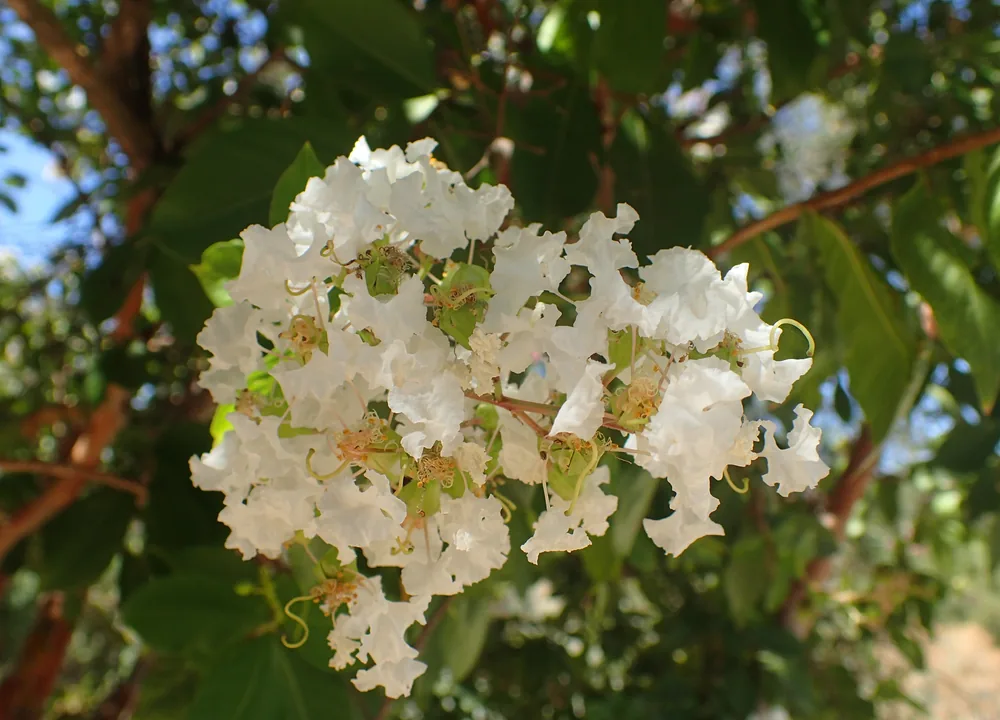
A panicle of Lagerstroemia indica flowers with crimped, crepe-paper petals in cream and pale pink, held above glossy oval leaves

Crape Myrtle

Lagerstroemia indica
Care level: Easy

Crape Myrtle is a small deciduous tree grown for late-summer flowers with crinkled, crepe-paper petals, in white, pink, magenta or deep red. It flowers when most trees and shrubs have finished, from July into September, and follows it with orange-red autumn colour and smooth cinnamon bark that peels to reveal paler patches beneath. It needs real summer heat to flower well, which is what decides whether it is worth planting where you live.

I have this plant

Information

Varieties and related species
Lagerstroemia indica 'Natchez'Lagerstroemia indica 'Rhapsody in Pink'Lagerstroemia x 'Zuni'

Light

Full sun, without qualification. This is the single most important factor, and it is the plant to put in the hottest, brightest corner you have.

Water

Water regularly during its first two or three summers. Established trees are notably drought-tolerant, and overwatering late in the season delays the wood ripening it needs before winter.

Humidity

Not a factor outdoors, though powdery mildew is worse in humid air with poor circulation, so give it room.

Soil

Well-drained and not too rich. It tolerates poor soil well; fertile soil produces lush growth and fewer flowers.

Temperature

Hardy to about -5°C.

Size

1.8-9m tall and wide, depending on the variety.

Growth speed

Fast

Hardiness

Hardy down to about -5°C. Source: RHS

Non-toxic to pets

Considered non-toxic to cats and dogs.

Source: ASPCA

Care by Season

Spring

Leaves appear late, often not until May, and a bare crape myrtle in April is normal rather than dead. Scratch the bark to check for green before giving up on it. Prune lightly now if needed.

Summer

Flowering from July. Deadheading the first spent panicles often brings a second, smaller flush in early autumn.

Autumn

Leaves turn orange to red before dropping, revealing the bark. Stop feeding and watering so the wood hardens.

Winter

Hardy only to about -5°C, so in frost-prone gardens grow it against a warm, sunny wall or overwinter it under cool glass. Mulch the root area, and expect frost to kill the tips, which is not a problem since it flowers on new growth.

Growing & Maintenance

Planting

In full sun, in well-drained soil that is not too rich, in a sheltered spot. Mulch the roots and water regularly during the first two or three summers.

Fertilising

Little or none. Rich soil gives lush leaves and fewer flowers.

Pruning

Thin lightly in late winter or spring, before new growth starts. Do not cut it back hard every year.

Propagation

From seed or stem cuttings.

Pests & Diseases

Common problems

No flowers

Most likely cause: Not enough summer heat, or not enough sun.
What to do: Grow it in the hottest, sunniest spot you have, for example against a south-facing wall.

White, powdery coating on leaves and buds

Most likely cause: Powdery mildew, worse in humid, still air.
What to do: Give it full sun and space, and choose a resistant variety.

Bare branches in April

Most likely cause: Normal. The leaves appear late, often not until May.
What to do: Wait. Do not prune out wood that only looks dead.

Shoot tips dead after winter

Most likely cause: Frost. It is hardy only to about -5°C.
What to do: Cut back to live wood in spring and protect the plant in winter.

Spotted leaves that drop early

Most likely cause: Cercospora leaf spot.
What to do: Clear fallen leaves and improve the airflow.

Pests & Diseases

Powdery mildew

Signs: White dusty coating on young leaves and flower buds, distorting them so the buds fail to open properly.
Treatment: Choose a resistant variety, give it full sun and space for air movement, and remove affected shoots. This is the most common problem the plant has in a cool damp climate.

Aphids

Signs: Colonies on the shoot tips with sticky honeydew below, often followed by black sooty mould growing on the honeydew.
Treatment: Rinse off with water; predators usually keep up. Wash the sooty mould off the leaves once the aphids have gone, as it blocks light.

Cercospora leaf spot

Signs: Dark angular spots on the leaves in late summer, with the surrounding tissue turning yellow or red before early leaf fall.
Treatment: Clear fallen leaves, improve airflow, and avoid overhead watering. Rarely serious enough to threaten an established tree.

FAQ

My crape myrtle grows well but never flowers. Why?

Almost always not enough summer heat, or not enough sun. It flowers on the current year's growth and needs a warm, sunny summer to ripen that growth and set buds; in a cool maritime climate it can grow happily for years and flower barely at all. Plant it against a south-facing wall to gather reflected heat, and do not feed with high-nitrogen fertiliser, which produces leaf at the expense of flower.

Should I cut it back hard every year?

No. Hard annual stubbing, sometimes called crape murder, produces a knuckle of thick scar tissue and a burst of weak whippy shoots that flop under the weight of the flowers. Because it flowers on new growth you can prune in late winter, but the right approach is light: shorten the previous year's flowered shoots, remove crossing and weak growth, and thin the crown so the bark shows. The bark is half the point of the tree and pruning it into a stump hides it.

Is Crape Myrtle safe for cats and dogs?

Yes, Crape Myrtle is not toxic to cats or dogs.

When does Crape Myrtle flower?

From July to September. It flowers on the current year's growth and needs a hot summer to bloom well.

How big does a Crape Myrtle get?

Between 1.8 and 9m tall and wide, depending on the variety. It grows fast in warmth.

How hardy is Crape Myrtle?

It is hardy only to about -5°C. In frost-prone gardens, grow it against a warm, sunny wall or overwinter it in a pot under cover.

You might also like