No results. Is a plant missing? Tell uscontact@wikiplant.net
Dwarf Baby Tears
Hemianthus callitrichoides
Care level: Hard
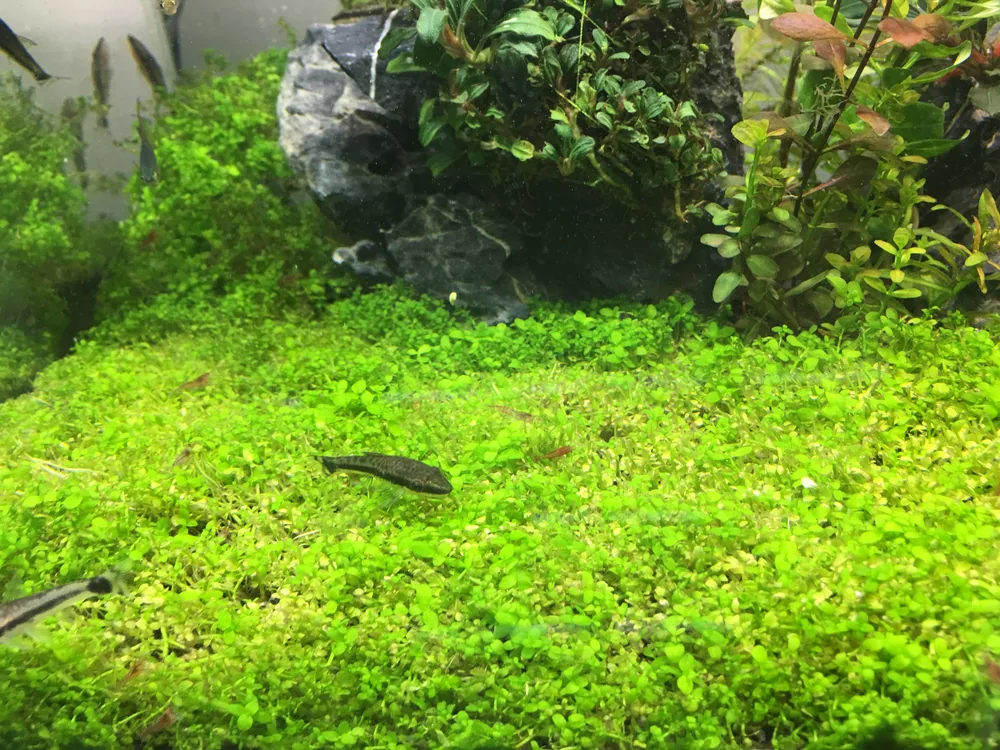
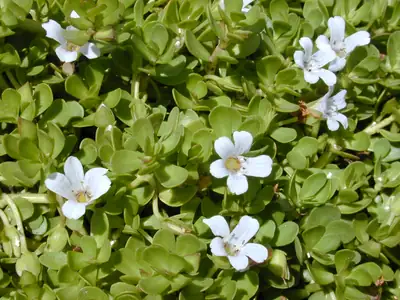
Discovered growing along the banks of a stream in Cuba, Hemianthus callitrichoides (often shortened to HC or "dwarf baby tears") has tiny, pinhead-sized round leaves that carpet the substrate so densely it resembles a lush green lawn, famously popularized in the competitive aquascaping world by Amano-style nature aquariums. It is widely regarded as one of the most demanding carpeting plants to establish successfully.
High light essential (~60+ PAR); under weaker light it grows upward instead of forming a low, dense carpet.
Water
Weekly 20-30% water changes; prefers soft, slightly acidic to neutral water, pH 6.0-7.0, 20-26°C.
CO2 & Feeding
Injected CO2 is essentially mandatory for successful carpeting; heavy liquid and root fertilization is also required to match its high growth demands.
Substrate
Fine-grained, nutrient-rich aquasoil is strongly preferred so its shallow root system can anchor and spread easily.
Temperature
20-26°C.
Tank Placement
Foreground
Common mistake
Attempting to grow Dwarf Baby Tears without pressurized CO2 injection is the single biggest cause of failure, it is realistically a high-tech-only plant, and low-tech attempts almost always melt away or get smothered by algae before carpeting.
Care by Season
Spring
Ideal planting season; press small tufts closely together into fine substrate to speed carpet formation.
Summer
Peak growth under strong light and CO2, trim the carpet surface regularly to keep it low and prevent shading of lower layers.
Autumn
Growth slows somewhat; maintain consistent CO2 and light to avoid algae taking hold as demand shifts.
Winter
Growth slows in cooler water; keep parameters stable since this species tolerates instability poorly.
Growing & Maintenance
Planting
Press small tufts close together into fine-grained, nutrient-rich aquasoil, in the foreground.
Fertilising
Heavy liquid and root fertilisation, together with injected CO2.
Trimming
Trim the surface of the carpet regularly to keep it low.
Pests & Diseases
Common problems
Carpet melting after planting
Most likely cause: The plant is adapting to submerged life in the tank.
What to do: Keep the light and CO2 high and stable. New, better-adapted growth follows.
Algae smothering the carpet
Most likely cause: CO2, light and nutrients out of balance.
What to do: Rebalance CO2, light and fertiliser dosing together.
Growing upward and not forming a carpet
Most likely cause: Light that is too weak.
What to do: Give it high light.
Very slow spread
Most likely cause: No injected CO2.
What to do: Add pressurised CO2. It is close to essential for this plant.
Decline after a change in the tank
Most likely cause: It tolerates instability poorly.
What to do: Keep the water parameters stable.
Pests & Diseases
Melting after planting
Signs: Tiny leaves turn brown or translucent and detach shortly after planting
Treatment: Maintain stable high light and CO2; new, better-adapted growth usually emerges from surviving stems within a few weeks.
Algae smothering the carpet
Signs: Green or black algae coating the tiny leaves, blocking growth
Treatment: Rebalance CO2, light, and nutrient dosing together, and add algae-eating shrimp; imbalance between these three factors is the usual root cause.
FAQ
Why is my Dwarf Baby Tears carpet melting or covered in algae?
This almost always points to insufficient CO2 or unstable lighting/nutrient balance, it needs consistently high light and injected CO2 together, since one without the other invites algae or melt.
How long does it take for Dwarf Baby Tears to carpet a tank?
Under strong light, CO2, and good nutrients, a full carpet typically takes six to ten weeks; without CO2 it may never fill in properly.
Does Dwarf Baby Tears need CO2?
Yes, in practice. Injected CO2 is essentially mandatory for a carpet, and growing it without is the main cause of failure.
How much light does Dwarf Baby Tears need?
High light. Under weaker light it grows upward and does not form a low, dense carpet.
What water does Dwarf Baby Tears need?
Soft, slightly acidic to neutral water at pH 6.0-7.0 and 20-26°C. Change 20-30% of the water every week.
How do I plant Dwarf Baby Tears?
Split it into small tufts and press them close together into fine substrate. Close planting speeds up the carpet.