No results. Is a plant missing? Tell uscontact@wikiplant.net
Floating fern
Salvinia natans
Care level: Easy
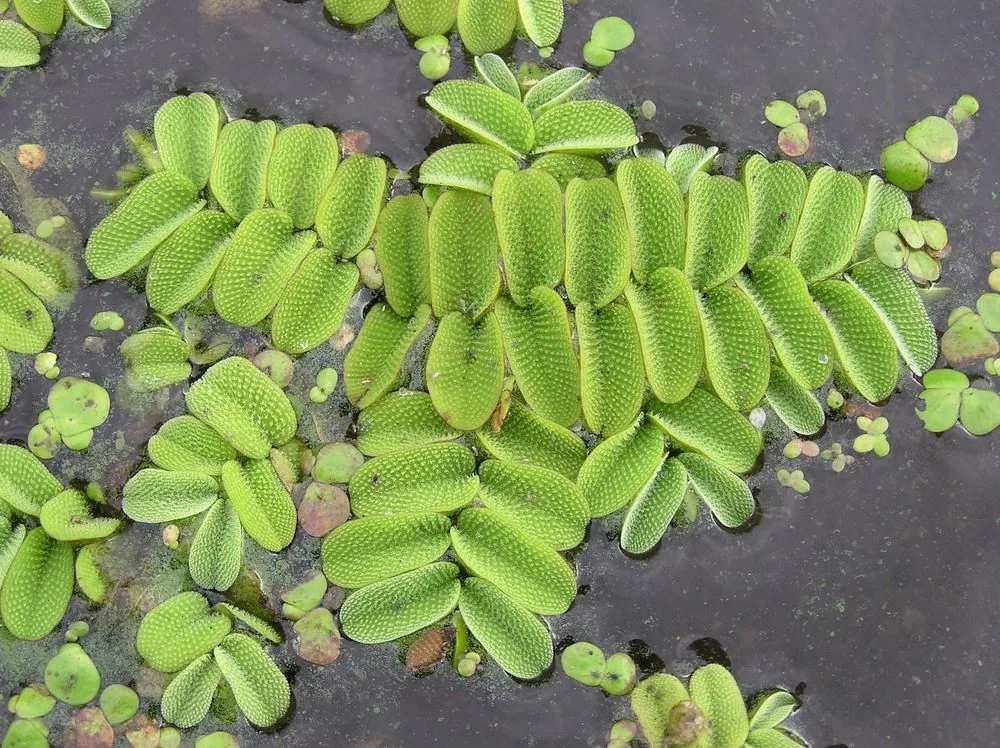
The floating fern is a small, free-floating water fern and the only Salvinia native to Europe. Each joint of its short stem carries three leaves: two oval, green ones that lie flat on the surface, covered in tiny water-repellent hairs, and a third that hangs in the water, finely divided and looking like a tuft of roots. The plant has no true roots. In an aquarium it spreads quickly across the surface, shades the tank, takes up nutrients and gives fry and shrimp cover among the hanging leaves.
Calm freshwater with little surface movement. Added CO2 is not needed, as the leaves take it from the air.
CO2 & Feeding
Not applicable; the floating leaves sit on the water surface.
Substrate
No substrate. It feeds from the water, so growth stalls in very clean, nutrient-poor tanks.
Size
Floating leaves about 1cm long on short, branching stems.
Growth speed
Fast
Tank Placement
Floating
Did you know?
What looks like roots is a leaf. The feathery brown threads under each pair of floating leaves are a third, submerged leaf, which takes up nutrients from the water and carries the spore capsules.
Care by Season
Spring
Outdoors, new plants grow from spores as the water warms. In a tank, growth picks up with longer days.
Summer
Growth is at its fastest. Thin the cover every week or two.
Autumn
Outdoors the plants form spore capsules and begin to die back.
Winter
In nature this annual fern survives winter only as spores on the bottom. In a heated, lit tank, floating ferns keep growing.
Growing & Maintenance
Planting
Float the plants on the surface in the calmest part of the tank. A ring of airline tubing keeps them away from the filter outlet and leaves open water for feeding.
Fertilising
A liquid fertiliser helps where leaves turn pale; in a stocked tank the fish usually supply enough.
Trimming
Scoop out surplus plants with a net and remove yellow or decaying ones.
Propagation
The stems branch and break apart into new plants by themselves.
Pests & Diseases
Common problems
Small, pale leaves
Most likely cause: Too little light or too few nutrients.
What to do: Give more light or add a liquid fertiliser.
Plants pushed under water and rotting
Most likely cause: Strong surface movement from the filter.
What to do: Calm the surface or fence the plants off with a floating ring.
The whole surface is covered
Most likely cause: Fast growth left unchecked.
What to do: Remove part of the cover regularly.
Plants below are declining
Most likely cause: Shade from the floating cover.
What to do: Keep a third or more of the surface open.
Leaves turning brown and falling apart
Most likely cause: Old plants at the end of their cycle, or a lack of nutrients.
What to do: Remove them; young side shoots take over.
Pests & Diseases
Aphids
Signs: Small dark insects clustered on the dry upper side of the floating leaves, in open tanks and ponds.
Treatment: Push the plants under water and swirl them to wash the insects off, or net out the affected plants.
Algae among the hanging leaves
Signs: Green threads tangled in the root-like submerged leaves.
Treatment: Lift the plants, rinse and pull the threads away, and reduce the light period or the feeding of the tank.
FAQ
Does the floating fern need planting?
No. Lay it on the water surface. It has no roots and takes everything it needs from the water through its hanging leaves.
How much light does it need?
Medium to bright light. As it floats right under the lamp it usually gets enough. In weak light the leaves stay small and pale.
Why are the plants bunched up in one corner or pushed under?
Too much surface movement. Floating ferns want calm water. Turn the filter outlet down or away from the surface, or hold the plants back with a floating ring.
Will it shade my other plants?
Yes, a full cover takes most of the light. Scoop out part of it every week or two so that light still reaches the plants below.
Is the plant I bought really Salvinia natans?
Often not. Several tropical Salvinia species are sold under this name. They are cared for in the same way, but one of them, Salvinia molesta, is on the EU list of invasive species and may not be sold or kept in the EU.
Can I put it in my pond or collect it from the wild?
Do not take it from the wild; it is rare and protected in parts of Europe. And never tip aquarium plants or tank water into a pond, ditch or stream. Dry out surplus plants and put them in the household waste.