No results. Is a plant missing? Tell uscontact@wikiplant.net
Hornwort
Ceratophyllum demersum
Care level: Easy
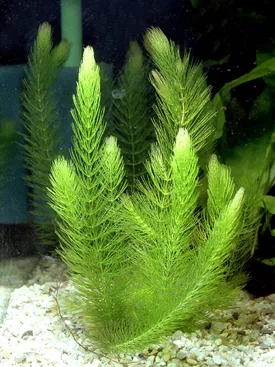
Hornwort is a truly rootless aquatic plant found in still and slow-moving freshwater worldwide, absorbing all its nutrients directly through its whorled, needle-like leaves rather than through roots. It is often used as a fast-growing "nutrient sponge" to combat algae in new tanks and as a spawning substrate for egg-scattering fish because of its dense, feathery texture.
Tolerates low light but grows fastest and densest under moderate to high light (~30-60 PAR), especially near the surface.
Water
Weekly 20-30% water changes; very adaptable, pH 6.0-7.5, 15-28°C, soft to hard water.
CO2 & Feeding
Grows without CO2 injection but multiplies rapidly with it; being rootless, it feeds entirely through water-column fertilization.
Substrate
No substrate used at all, it is left loose, floating, or weighted down rather than planted; it has no true root system.
Temperature
15-28°C.
Growth speed
Fast
Tank Placement
Floating
Common mistake
Hornwort constantly sheds its lower needle leaves as it grows, which is normal senescence, not disease or poor water quality, the debris just needs regular vacuuming so it doesn't foul the substrate.
Care by Season
Spring
Rapid growth resumes; trim and redistribute cuttings, which root nowhere and simply continue growing wherever placed.
Summer
Fastest growth of the year, vacuum shed needle debris from the substrate more frequently.
Autumn
Growth slows; thin out dense floating mats so light still reaches plants and fish below.
Winter
Growth nearly stops in cooler water; some shedding is normal as the plant enters a resting state.
Growing & Maintenance
Planting
Do not plant it. It has no true roots, so leave it loose or floating, or weigh it down.
Trimming
Thin the floating mass by removing handfuls, and trim stems that have grown too long.
Propagation
Any cut piece carries on growing as a new plant.
Pests & Diseases
Common problems
Needles shedding
Most likely cause: Normal on older sections, and stronger after a move or a change of light.
What to do: Vacuum the debris during water changes and trim back the oldest parts.
Plants below losing light
Most likely cause: A dense floating mat.
What to do: Thin the mass regularly.
Needles covering the substrate
Most likely cause: Constant shedding as the plant grows.
What to do: Vacuum the substrate more often in peak growth.
The lower end rotting
Most likely cause: The stem was pushed into the substrate.
What to do: Leave it loose or weigh it down. Do not bury it.
Growth almost stopping
Most likely cause: Cool water.
What to do: Nothing to do. Some shedding is normal while the plant rests.
Pests & Diseases
Needle shedding / fragmentation
Signs: Loose green needle leaves accumulating on the substrate
Treatment: Vacuum debris during water changes and trim overly fragmented stems; increase stability of lighting and temperature to reduce stress shedding.
Blocking light to lower plants
Signs: Dense floating mat shading out carpet or midground plants
Treatment: Thin the mass regularly by removing handfuls, since Hornwort grows fast enough to require frequent trimming.
FAQ
Does Hornwort need to be planted in substrate?
No, it has no true roots and grows just as well left loose or floating at the surface; if pushed into substrate it will simply anchor loosely but draws nutrients from the water column either way.
Why does my Hornwort keep shedding needles?
Older sections naturally shed leaves as the plant grows, especially after being moved or under changing light; this is normal, though very heavy shedding can signal a sudden environment change.
Does Hornwort need CO2?
No. It grows without injected CO2, and multiplies rapidly with it.
How much light does Hornwort need?
It tolerates low light, but grows fastest and densest under moderate to high light near the surface.
What water does Hornwort need?
It is very adaptable: pH 6.0-7.5, 15-28°C, soft to hard water. It feeds entirely from the water, as it has no roots.
How do I trim Hornwort?
Cut the stems to length and remove handfuls of the floating mass. The pieces you cut off can go back in, since each one grows on.