No results. Is a plant missing? Tell uscontact@wikiplant.net
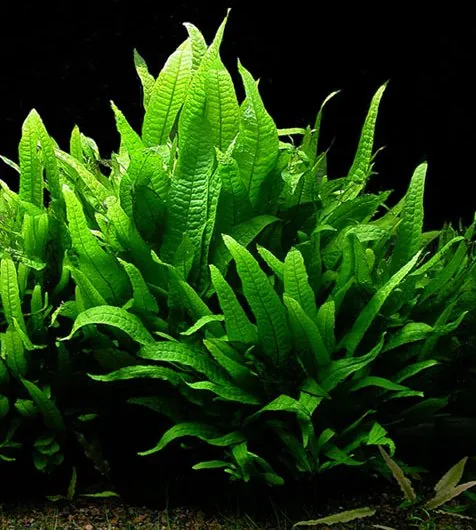
Java Fern
Microsorum pteropus
Care level: Easy
Java Fern grows naturally on rocks and driftwood along shaded rivers and streams in Southeast Asia, anchoring itself with a creeping rhizome rather than true roots in soil. Its toughness and tolerance of low light and inconsistent water conditions have made it one of the most recommended plants for beginner tanks and even goldfish or cichlid setups where soil-rooted plants get uprooted.
Low aquarium lighting is sufficient (~10-20 PAR); tolerates shaded corners and thrives in low-tech tanks without added CO2.
Water
Weekly 20-30% water changes; adaptable to a wide range, pH 6.0-7.5, 20-28°C, soft to fairly hard water.
CO2 & Feeding
No CO2 required, though light supplementation speeds growth; liquid fertilizer helps but is not essential since it draws few nutrients through its rhizome.
Substrate
No substrate needed, the rhizome must stay unburied. Tie to driftwood or rock with thread or fishing line, or attach with cyanoacrylate gel glue until it self-anchors.
Temperature
20-28°C. Keep it steady.
Tank Placement
Attached to hardscape
Common mistake
Never bury the rhizome (the thick horizontal stem the leaves grow from) in substrate, it will rot within weeks. Tie or glue it to hardscape instead and it will slowly grow its own root network over the wood or rock.
Care by Season
Spring
A good time to divide overcrowded rhizomes and tie off new fern clusters onto fresh hardscape.
Summer
Watch for black spot algae on older, slow-growing leaves if tank lighting runs long during warmer months.
Autumn
Growth slows naturally; trim any blackened or algae-covered older leaves to keep the rhizome healthy.
Winter
Very tolerant of cooler temperatures, but keep the heater steady since sudden drops can stress the rhizome.
Growing & Maintenance
Planting
Tie it to driftwood or rock with thread or fishing line. Never bury the rhizome in the substrate.
Fertilising
Liquid fertiliser helps, but is not essential.
Trimming
Trim blackened or algae-covered older leaves to keep the rhizome healthy.
Propagation
Divide an overcrowded rhizome and tie the pieces to new wood or rock.
Pests & Diseases
Common problems
Black, mushy base
Most likely cause: Rhizome rot, from a rhizome that was buried or pressed too tightly against a surface.
What to do: Cut away all the affected tissue with clean scissors and fix the rhizome so that it sits free.
Dark tufts of algae on the leaves
Most likely cause: Black beard algae.
What to do: Remove the worst-affected leaves and improve the water flow.
Black spots on older leaves
Most likely cause: Algae on slow-growing leaves when the lights run long.
What to do: Shorten the lighting period and trim the affected leaves.
Very slow growth
Most likely cause: Normal, especially in low light without CO2.
What to do: Nothing is needed. More light speeds it up a little.
Leaves suffering after a cold snap
Most likely cause: A sudden drop in temperature stresses the rhizome.
What to do: Keep the heater steady.
Pests & Diseases
Rhizome rot
Signs: Rhizome turns black or brown and feels soft or slimy
Treatment: Cut away all affected tissue with clean scissors and re-anchor the healthy portion above the substrate with better flow around it.
Black beard algae on leaves
Signs: Dark bristly tufts on older, slower-growing leaves
Treatment: Manually remove worst-affected leaves, improve flow, and reduce light duration or add algae-eating shrimp.
FAQ
Why is my Java Fern turning black and mushy at the base?
This is almost always rhizome rot from the rhizome being buried in substrate or pressed too tightly against a surface with no water flow. Trim the affected tissue and re-attach the healthy rhizome above the substrate line.
Do I need CO2 or strong lighting for Java Fern?
No, it is one of the few aquarium plants that thrives under low light and no injected CO2, though growth will be faster and leaves larger with moderate light and nutrients.
What water does Java Fern need?
It adapts to a wide range: pH 6.0-7.5, 20-28°C, soft to fairly hard water. Change 20-30% of the water every week.
How do I attach Java Fern?
Tie it to driftwood or rock with thread or fishing line. The roots grip the surface themselves, and the rhizome must stay unburied.
How do I propagate Java Fern?
By division. Cut an overcrowded rhizome into pieces and tie each one to fresh hardscape.
How fast does Java Fern grow?
Slowly. It is a low-light plant that puts out new leaves at an unhurried pace.