No results. Is a plant missing? Tell uscontact@wikiplant.net
Rhipsalis
Rhipsalis baccifera
Care level: Easy
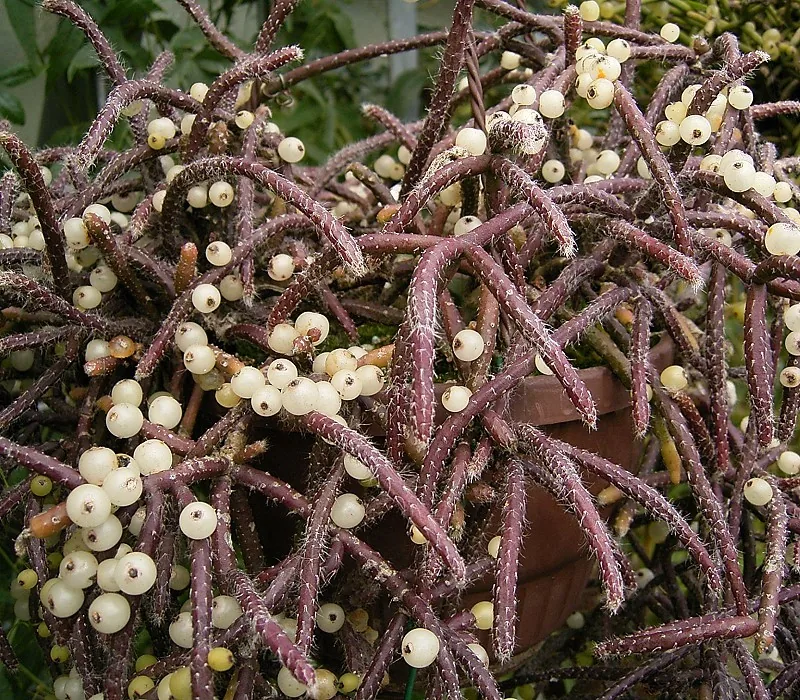
Rhipsalis is a cactus that has abandoned nearly every stereotype of the family: no spines, no desert habitat, and a preference for the humid, shaded canopy of South American rainforests where it grows as an epiphyte on tree branches. Its thin, trailing stems and small translucent berries look more like something between a succulent and mistletoe, which is exactly where its common name, mistletoe cactus, comes from.
Bright, indirect light; as an epiphytic forest cactus it dislikes intense direct sun.
Water
Water when the top few centimeters of mix dry out, roughly every 7-10 days, more than a desert cactus needs.
Humidity
Appreciates moderate to high humidity, reflecting its rainforest origins.
Soil
Light, well-draining mix such as cactus soil blended with orchid bark or peat.
Temperature
16-27°C. A slightly cooler spot in winter encourages flowering.
Size
Trailing stems 1.2-1.8m long, with time.
Growth speed
Slow
Best position
north / north-east-facing windowanywhere up to about 1 m from the window
east-facing windowabout 1 m from the window or further back
west-facing windowabout 2 m from the window or further back
Watch for strong direct sun at east / west windows.
See every window directionHide window directions
Best position
right by the window
about 1 m
about 2 m
about 4 m
4 m or more
north
works well✓
works well✓
too dark○
too dark○
too dark○
north-east
works well✓
works well✓
too dark○
too dark○
too dark○
east
just about~
works well✓
works well✓
too dark○
too dark○
south-east
too much direct sun☼
just about~
just about~
too dark○
too dark○
south
too much direct sun☼
too much direct sun☼
too much direct sun☼
too dark○
too dark○
south-west
too much direct sun☼
too much direct sun☼
just about~
too dark○
too dark○
west
too much direct sun☼
too much direct sun☼
works well✓
too dark○
too dark○
north-west
too much direct sun☼
just about~
too dark○
too dark○
too dark○
✓works well~just about○too dark☼too much direct sun
A rough guide based on window direction and typical daylight through the year. Window size, curtains and whatever stands outside matter just as much.
?Pet safety not confirmed
As a precaution, keep it out of reach of children and pets.
Did you know?
Rhipsalis baccifera is the only cactus species found growing wild outside the Americas, with populations naturally occurring in parts of Africa, Madagascar, and Sri Lanka, likely spread long ago by birds eating its sticky berries.
Care by Season
Spring
Resume regular watering and begin light monthly feeding as trailing stems put out new growth.
Summer
Water a bit more often and mist occasionally to mimic humid forest conditions.
Autumn
Reduce watering frequency gradually and stop feeding by late autumn.
Winter
Let it dry out more between waterings and keep in a slightly cooler spot to encourage flowering.
Growing & Maintenance
Soil and pot
A light, well-draining mix, such as cactus soil blended with orchid bark, in a hanging pot with drainage holes.
Fertilising
A light feed once a month in spring and summer. Stop by late autumn.
Propagation
From stem cuttings set in light, barely moist mix.
Pests & Diseases
Common problems
Stem segments dropping
Most likely cause: A long dry spell, or waterlogged mix.
What to do: Water when the top few centimetres have dried and make sure the pot drains freely.
Thin, shrivelled stems
Most likely cause: Too little water. It needs more than a desert cactus.
What to do: Water more often, roughly every 7-10 days in the growing season.
Yellowed or scorched stems
Most likely cause: Intense direct sun.
What to do: Move it to bright, indirect light.
Mushy stems at the base
Most likely cause: Root rot from mix that stays wet.
What to do: Cut away the rotten sections, let the plant dry out and repot in a lighter mix.
No flowers
Most likely cause: No winter rest.
What to do: In winter, let it dry out more between waterings and keep it slightly cooler.
Pests & Diseases
Mealybugs
Signs: White cottony spots along the trailing stems.
Treatment: Dab with an alcohol-soaked cotton swab and repeat every few days. Check the undersides of the leaves and the crevices where the leaf stem meets the main stalk.
Scale insects
Signs: Small brown bumps stuck to stems that are hard to remove.
Treatment: Scrape off gently and follow with insecticidal soap application.
Treatment: Cut away rotten sections, let the plant dry out, and repot into fresh, well-draining mix.
FAQ
Why is my rhipsalis dropping segments of its trailing stems?
Segment drop is often a stress response to either prolonged dryness or waterlogged soil; check that you're watering when the top layer dries rather than letting it go bone dry or stay soggy.
Can rhipsalis handle the same care as a desert cactus?
No, despite being a true cactus, it comes from humid rainforest canopies, so it wants more frequent watering, higher humidity, and less direct sun than a typical desert cactus.
How much light does a Rhipsalis need?
It needs bright, indirect light. It is a forest cactus that grows on trees, so intense direct sun damages the stems.
How do I propagate a Rhipsalis?
From stem cuttings. Set a piece of stem in light, barely moist mix and keep it in bright, indirect light until it roots.
How long do the stems of a Rhipsalis get?
Between 1.2 and 1.8m, with time. It grows slowly, so a young plant takes years to trail that far.
When does a Rhipsalis flower?
From late winter to early spring, with small white flowers. A slightly cooler, drier winter helps it bloom.