No results. Is a plant missing? Tell uscontact@wikiplant.net
String of Hearts
Ceropegia woodii
Care level: Easy
String of hearts grows from an underground tuber and produces thread-thin vines that can trail for several meters, occasionally sprouting small aerial tubers called bulbils along the stem that look like tiny potatoes. In parts of southern Africa it has a long history as a traditional plant, and its heart-shaped, marbled leaves have made it one of the most photographed trailing houseplants in recent years.
Bright light with some direct sun; insufficient light causes long gaps between leaves.
Water
Let soil dry out completely between waterings, roughly every 2-3 weeks, as it stores water in a tuber and leaves.
Humidity
Tolerates low, average household humidity well and prefers good air circulation.
Soil
Fast-draining succulent mix with extra perlite or pumice.
Temperature
Normal room temperatures, with a bright, cool spot in winter.
Size
Stems trail to about 90cm.
Growth speed
Fast
Best position
south-east / south-facing windowanywhere up to about 1 m from the window
east / west-facing windowright by the window
south-west-facing windowabout 1 m from the window or further back
Watch for strong direct sun at south-west windows.
See every window directionHide window directions
Best position
right by the window
about 1 m
about 2 m
about 4 m
4 m or more
north
too dark○
too dark○
too dark○
too dark○
too dark○
north-east
too dark○
too dark○
too dark○
too dark○
too dark○
east
works well✓
too dark○
too dark○
too dark○
too dark○
south-east
works well✓
works well✓
too dark○
too dark○
too dark○
south
works well✓
works well✓
too dark○
too dark○
too dark○
south-west
just about~
works well✓
too dark○
too dark○
too dark○
west
works well✓
too dark○
too dark○
too dark○
too dark○
north-west
too dark○
too dark○
too dark○
too dark○
too dark○
✓works well~just about○too dark☼too much direct sun
A rough guide based on window direction and typical daylight through the year. Window size, curtains and whatever stands outside matter just as much.
?Pet safety not confirmed
As a precaution, keep it out of reach of children and pets.
Propagation tip
The little bead-like bulbils that form along the vines are baby plants in waiting: press one onto moist soil while it's still attached or snip it off, and it will readily root into a whole new plant.
Care by Season
Spring
Resume watering as the soil dries and start light monthly feeding as new vines lengthen.
Summer
Water once the soil is fully dry and provide bright light to keep leaf coloring vivid.
Autumn
Reduce watering frequency and stop feeding as growth slows down.
Winter
Water sparingly, roughly once a month, and keep in a bright, cool spot away from cold drafts.
Growing & Maintenance
Soil and pot
A fast-draining succulent mix with extra perlite or pumice, in a pot with drainage holes.
Repotting
Only when necessary.
Fertilising
A light feed once a month in spring and summer. None in autumn and winter.
Support
It trails naturally, but the vines can be trained around a small trellis or hoop.
Propagation
From stem cuttings, by laying a vine on soil so it roots, or from the small tubers that form on the stems.
Pests & Diseases
Common problems
Long bare gaps between leaves
Most likely cause: Too little light.
What to do: Move it to bright light with some direct sun.
Yellow, mushy leaves
Most likely cause: Overwatering, which rots the tuber and roots.
What to do: Stop watering and let the mix dry out completely.
Thin, wrinkled, wilting leaves
Most likely cause: Underwatering.
What to do: Water thoroughly, then let the mix dry out again.
Scorched leaves
Most likely cause: Hot midday sun behind glass.
What to do: Give it bright light with gentler morning or evening sun.
White, cottony clusters
Most likely cause: Mealybugs.
What to do: Dab them with a cotton swab dipped in alcohol and repeat until they are gone.
Pests & Diseases
Mealybugs
Signs: White cottony tufts at leaf nodes or along the thin vines.
Treatment: Dab with alcohol-soaked cotton swab and repeat every few days until clear. Check the undersides of the leaves and the crevices where the leaf stem meets the main stalk.
Spider mites
Signs: Fine webbing and tiny pale dots on leaves in dry conditions.
Treatment: Increase humidity slightly, rinse foliage, and apply insecticidal soap if needed. Check the undersides of the leaves and the crevices where the leaf stem meets the main stalk.
Tuber and root rot
Signs: Soft, mushy tuber at the soil surface and wilting vines from overwatering.
Treatment: Stop watering, let the soil dry fully, and remove any decayed tuber tissue.
FAQ
What are the small round nodules growing along my string of hearts vines?
Those are bulbils, tuber-like structures the plant produces for propagation; they can be left on the vine, pressed into soil to root while attached, or removed and planted to grow new plants.
Why does my string of hearts have long bare stretches between leaves?
Wide gaps between leaves, a condition called etiolation, almost always mean the plant needs more light; move it to a brighter spot with some direct sun and new growth should come in more compact.
How often should I water a String of Hearts?
Roughly every 2-3 weeks, once the mix has dried out completely. In winter it rests, so water about once a month.
How do I propagate a String of Hearts?
From stem cuttings, by layering or from tubers. Press a vine or one of its small tubers onto moist mix and it roots where it touches.
Does a String of Hearts flower?
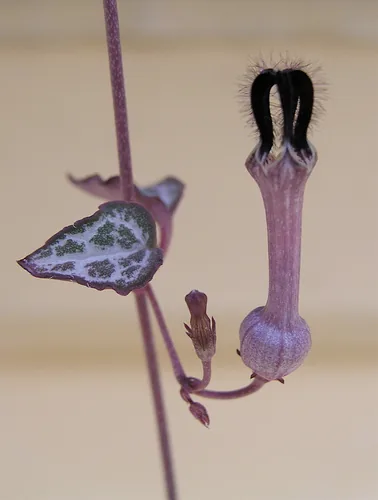
Yes. It carries small purplish, tubular flowers in summer and autumn.
How long does a String of Hearts get?
The stems trail to about 90cm indoors. It grows fast in good light.