No results. Is a plant missing? Tell uscontact@wikiplant.net
Staurogyne
Staurogyne repens
Care level: Easy
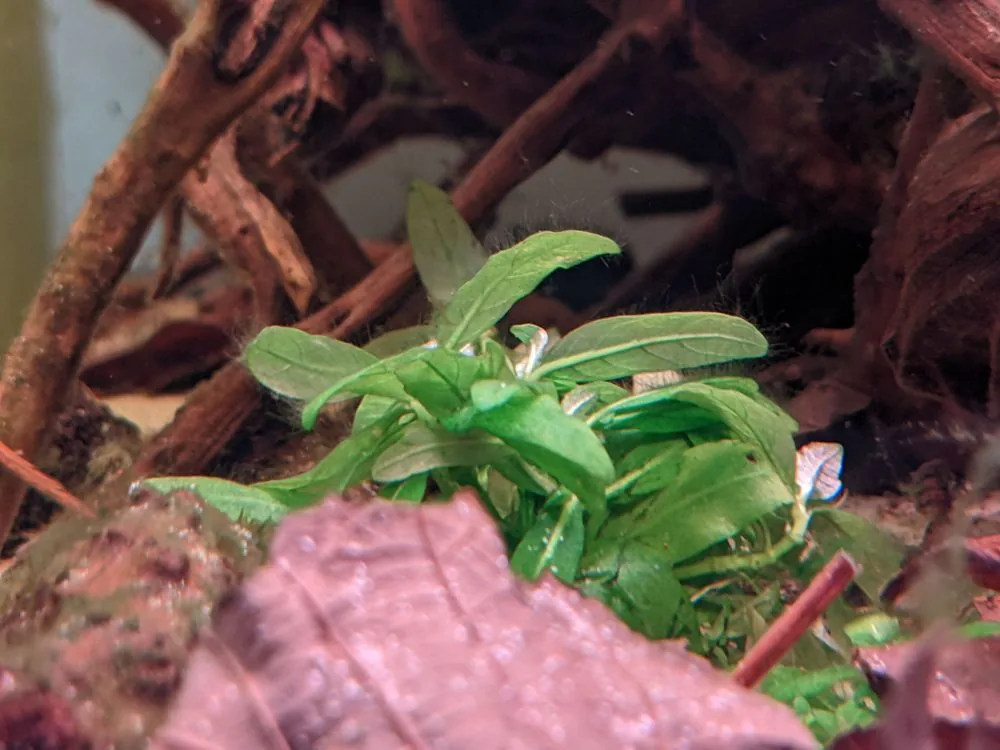
Staurogyne repens is a low, bushy stem plant from the Rio Cristalino in the southern Amazon region of Brazil, and one of the most forgiving choices for the front of a planted tank. It has small, firm, fresh green leaves on short stems, grows only 3-10cm tall and spreads by side shoots that creep over the substrate, so a few stems thicken into a dense, low hedge or carpet. It is related to Hygrophila but stays far more compact and grows more slowly. It is hardy, tolerates a wide range of water and rewards good light and CO2 with tighter growth.
Medium to strong light for low, dense growth. It tolerates less but grows taller.
Water
Ordinary tropical freshwater. Added CO2 is not essential but gives denser, faster growth.
CO2 & Feeding
Not applicable; this is a fully submerged plant.
Substrate
A fine gravel, sand or aquarium soil that holds the short stems. It feeds through roots and leaves, so root tabs and a liquid fertiliser both help.
Size
3-10cm tall; each stem 5-10cm across.
Growth speed
Medium
Tank Placement
Foreground
Beginner tip
Cut off the tallest upright shoots when you plant it and again whenever they rise above the rest. The plant answers with horizontal side shoots from the base, and that is what turns separate stems into a carpet. The cut tops can be replanted.
Care by Season
Spring
Growth is steady all year in a heated, lit tank. Trim upright shoots as they appear.
Summer
Growth is at its fastest under long, bright light. Replant the cut tops to fill gaps.
Autumn
Thin the carpet if it has grown too thick and the lowest leaves are dying.
Winter
No rest period. Keep the light and fertiliser steady.
Growing & Maintenance
Planting
Separate the stems and plant them singly with tweezers, 2-3cm apart, in the foreground. Remove any rock wool from the roots first.
Fertilising
Use root tabs under the carpet and a regular liquid fertiliser. Pale new leaves point to a lack of nutrients.
Trimming
Trim upright shoots back to the level of the carpet with scissors. When the carpet becomes too thick, lift it, cut it back and replant the healthiest tops.
Propagation
By cuttings: replant the trimmed tops, or cut off side shoots that have rooted.
Pests & Diseases
Common problems
Tall, sparse stems
Most likely cause: Too little light.
What to do: Increase the light and trim the tops.
Stems float up after planting
Most likely cause: Shallow planting, or fish digging.
What to do: Plant deeper with tweezers and weigh the area down with small stones until rooted.
Pale or yellow new leaves
Most likely cause: A lack of nutrients, often iron or nitrogen.
What to do: Add a liquid fertiliser and root tabs.
Lower leaves die inside the carpet
Most likely cause: A carpet grown too thick, shading itself.
What to do: Thin and replant.
Very slow growth
Most likely cause: No added CO2 or low light.
What to do: Accept the pace, or add CO2 and light.
Pests & Diseases
Algae on the leaves
Signs: Dark tufts or green spots on the older, lower leaves, which grow slowly and sit in strong light.
Treatment: Remove the worst leaves, keep nutrients and CO2 steady and shorten the light period if it continues.
Leaf melt after planting
Signs: Leaves that turn glassy and fall apart in the first weeks.
Treatment: Remove the decaying leaves and leave the stems in place; new submerged leaves follow.
FAQ
Does Staurogyne repens need CO2?
It grows without it, but slowly and more upright. With added CO2 and good light it stays low, branches freely and forms a carpet much faster.
How much light does it need?
It survives in fairly low light, but then grows taller with few side shoots. Medium to strong light keeps it compact and creeping.
How do I plant it?
Split the pot or cup into single stems and push them a couple of centimetres into the substrate with tweezers, 2-3cm apart. Planted close like this, they knit together within a few months.
Why is it growing upwards instead of spreading?
Too little light, or shade from taller plants. Give more light, and trim the upright shoots so that the plant branches from the base.
Why are the lower leaves dropping?
Newly planted stems often shed leaves grown above water before making new, submerged ones. In an established clump it points to shade at the base or too few nutrients.
Is it suitable for a small tank?
Yes. Its low growth and small leaves suit nano tanks, where it works as a foreground or even a mid-ground plant.