No results. Is a plant missing? Tell uscontact@wikiplant.net
Calathea ornata
Goeppertia ornata
Care level: Hard
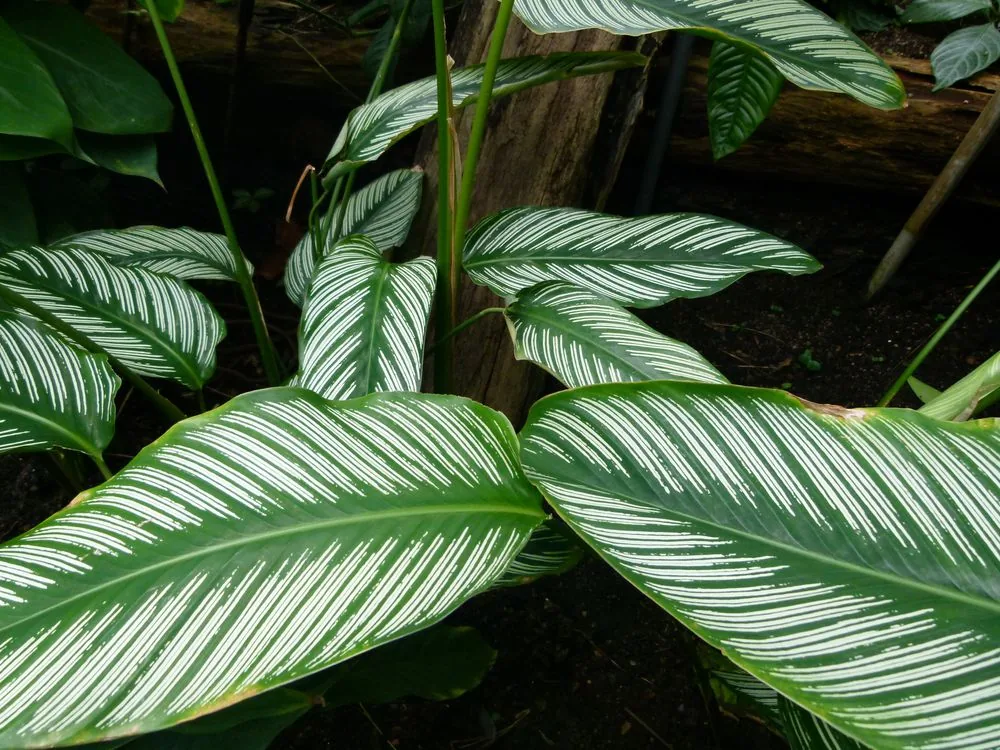
Calathea ornata, the pinstripe calathea, is a clump-forming foliage plant from the rainforest floor of Colombia and Venezuela. Its broad oval leaves stand on long stalks and are dark green with pairs of thin stripes, as if drawn with a fine brush, and purplish underneath. Like its relatives in the prayer plant family it raises its leaves in the evening and lowers them again by day. It is a demanding houseplant that needs steady warmth, high humidity and no draughts.
Bright, indirect or filtered light. No direct sun.
Water
Water freely while it is growing so the compost stays evenly moist, and reduce watering in winter.
Humidity
High. Group it with other plants, stand it on a tray of wet pebbles or use a humidifier.
Soil
Peat-free potting compost that holds moisture but drains freely.
Temperature
A constant temperature of at least 16°C, with no draughts.
Size
30-90cm tall and 30-90cm wide.
?Pet safety not confirmed
As a precaution, keep it out of reach of children and pets.
Signature feature
The stripes are pale pink on young leaves and fade to white as each leaf matures and darkens. A plant with white stripes on its older leaves and pink ones on its newest is healthy, not losing its colour.
Care by Season
Spring
Growth resumes. Divide or repot crowded plants in late spring and start feeding monthly.
Summer
Keep the compost evenly moist and the humidity high. Shade it from direct sun.
Autumn
Growth slows. Reduce watering and stop feeding.
Winter
Keep it warm, above 16°C, away from radiators and cold windows, and water sparingly.
Growing & Maintenance
Soil and pot
Use a peat-free compost that holds moisture yet drains freely, in a pot with drainage holes.
Repotting
Repot in late spring when the clump fills its pot, into a pot one size larger.
Fertilising
Feed monthly with a general houseplant fertiliser during the growing season.
Pruning
Cut off browned leaves at the base, and cut down flower spikes once they have finished.
Propagation
By division in late spring, keeping the divisions warm and humid until they are established.
Pests & Diseases
Common problems
Brown, crisp leaf edges
Most likely cause: Dry air.
What to do: Raise the humidity and move it away from heat sources.
Curled leaves
Most likely cause: Dry compost or very dry air.
What to do: Water thoroughly and raise the humidity.
Faded stripes and scorched patches
Most likely cause: Direct sun.
What to do: Move it to bright, indirect light.
Yellowing lower leaves
Most likely cause: Compost that stays too wet.
What to do: Let the surface dry slightly between waterings and check the drainage.
Drooping leaves in a cold spot
Most likely cause: A draught or a temperature below 16°C.
What to do: Move it somewhere warm and sheltered.
No new growth
Most likely cause: Too little light or winter rest.
What to do: Give it more indirect light and wait for spring.
Pests & Diseases
Spider mites
Signs: Fine pale speckling on the leaves and thin webbing underneath, in warm, dry air.
Treatment: Rinse the leaves under a lukewarm shower and raise the humidity, which is also what the plant wants. Check the undersides of the leaves and the crevices where the leaf stem meets the main stalk.
Whiteflies
Signs: Tiny white insects that fly up when the plant is touched, with sticky leaves.
Treatment: Hang yellow sticky traps and rinse the undersides of the leaves regularly.
Root rot
Signs: Yellowing leaves and a sour-smelling compost that never dries.
Treatment: Remove the plant from its pot, cut away soft brown roots and repot in fresh, free-draining compost.
FAQ
Why are the leaf edges of my Calathea ornata turning brown?
Dry air is the usual cause. This plant comes from the humid forest floor and browns at the edges in the air of a heated room. Raise the humidity around it, keep it away from radiators and draughts, and keep the compost evenly moist.
Why do the leaves curl up?
Curled leaves mean the plant is short of water, either because the compost has dried or because the air is so dry that the leaves lose water faster than the roots supply it. Water thoroughly and raise the humidity; the leaves flatten again.
How much light does Calathea ornata need?
Bright, indirect or filtered light. Direct sun fades the markings and scorches the leaves; a spot that is too dark slows growth to a stop.
Why do the leaves move?
It is normal. The leaves rise towards upright in the evening and spread out again in the morning, a daily rhythm shared by the whole prayer plant family.
Why have the pink stripes turned white?
That is how the leaf matures. The stripes are pink on young leaves and whiten with age, so only the newest leaves show the pink.
How do I propagate Calathea ornata?
By division in late spring. Split the clump into sections that each have roots and several leaves, pot them up and keep them warm and humid until they are growing again.