No results. Is a plant missing? Tell uscontact@wikiplant.net
Anthurium
Anthurium andraeanum
Care level: Moderate
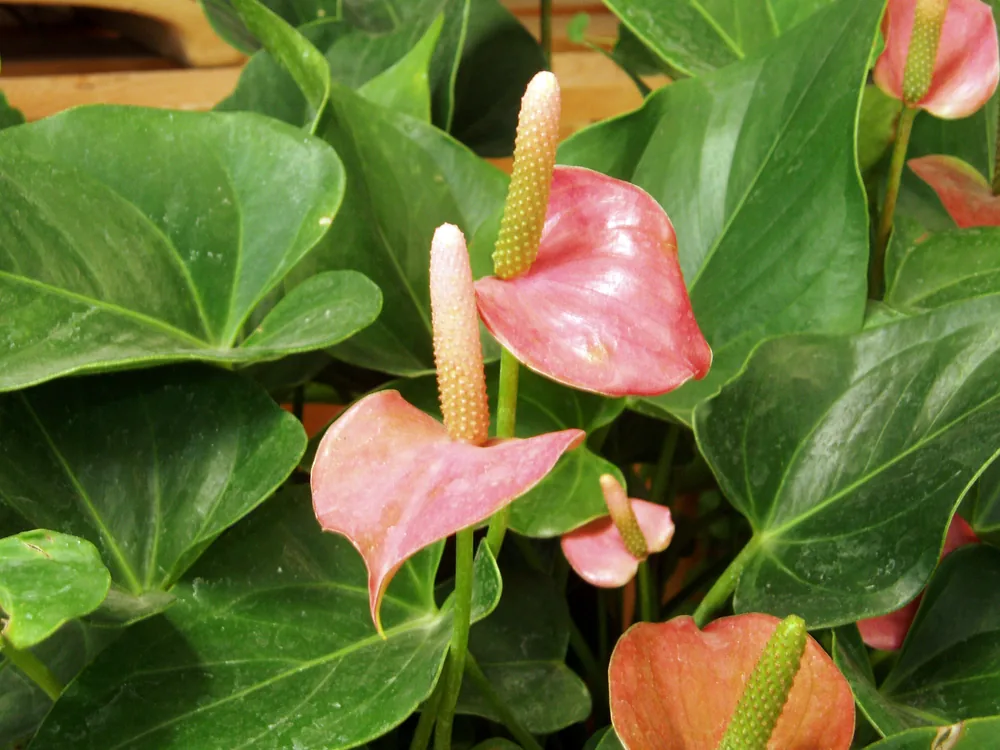
The glossy, heart-shaped 'flower' that gives anthurium its year-round appeal isn't a petal at all but a modified leaf called a spathe, with the true, tiny flowers packed onto the finger-like spadix that rises from its center, and a single bloom can last for weeks.
Prefers bright, indirect light for best flowering; too little light reduces blooms.
Water
Water when the top 2-3cm of soil is dry, roughly every 1-2 weeks; avoid soggy soil.
Humidity
Enjoys high humidity of 60% or more; mist or use a humidifier for best growth.
Soil
Chunky, well-draining aroid mix with bark and perlite.
Temperature
18-27°C.
Size
30-45cm tall and 23-30cm wide.
Growth speed
Slow
Best position
east / south-east-facing windowanywhere up to about 2 m from the window
north / north-east / north-west-facing windowanywhere up to about 1 m from the window
south / west-facing windowabout 1 m from the window or further back
Watch for strong direct sun at south / west windows.
See every window directionHide window directions
Best position
right by the window
about 1 m
about 2 m
about 4 m
4 m or more
north
works well✓
works well✓
too dark○
too dark○
too dark○
north-east
works well✓
works well✓
too dark○
too dark○
too dark○
east
works well✓
works well✓
works well✓
too dark○
too dark○
south-east
works well✓
works well✓
works well✓
too dark○
too dark○
south
just about~
works well✓
works well✓
too dark○
too dark○
south-west
just about~
just about~
works well✓
too dark○
too dark○
west
just about~
works well✓
works well✓
too dark○
too dark○
north-west
works well✓
works well✓
too dark○
too dark○
too dark○
✓works well~just about○too dark☼too much direct sun
A rough guide based on window direction and typical daylight through the year. Window size, curtains and whatever stands outside matter just as much.
!Toxic to pets
Toxic to cats and dogs if eaten.
Chewing it can irritate the mouth, causing drooling and trouble swallowing.
If your pet has eaten some, contact your vet.
Source: ASPCA, which lists Anthurium scherzeranum, a related species rather than this one.
Did you know?
Because the colorful spathe is actually a leaf rather than a true flower, individual anthurium blooms are unusually long-lasting, often staying attractive on the plant for six to eight weeks before fading.
Care by Season
Spring
Resume feeding every few weeks to support new blooms and leaves.
Summer
Keep humidity high and water consistently for continuous flowering.
Autumn
Reduce feeding frequency as blooming naturally slows.
Winter
Water sparingly and keep away from cold drafts; expect fewer blooms.
Growing & Maintenance
Soil and pot
A chunky, well-draining aroid mix with bark and perlite, in a pot with drainage holes.
Repotting
Every 2-3 years, in spring.
Fertilising
A liquid feed every few weeks through the growing season. Too few nutrients mean fewer flowers.
Pruning
Cut faded flowers and yellow leaves off at the base of their stalk.
Propagation
By division at repotting, or from stem cuttings.
Pests & Diseases
Common problems
No flowers
Most likely cause: Too little light or too few nutrients.
What to do: Move it to bright, indirect light and feed regularly in the growing season.
Yellow leaves
Most likely cause: Overwatering, poor drainage or a lack of nutrients.
What to do: Let the top 2-3cm dry before watering, check that the pot drains and feed in season.
Spots on the leaves
Most likely cause: Wet foliage and poor air circulation.
What to do: Keep the leaves dry when watering and give the plant more air.
Scorched patches
Most likely cause: Direct sunlight.
What to do: Move it out of the sun into bright, indirect light.
Brown, dry leaf tips
Most likely cause: Air that is too dry.
What to do: Keep the humidity at 60% or more.
Pests & Diseases
Spider mites
Signs: Fine webbing and stippled, dull leaves in dry conditions.
Treatment: Increase humidity, rinse leaves, and apply insecticidal soap. Check the undersides of the leaves and the crevices where the leaf stem meets the main stalk.
Mealybugs
Signs: White cottony clumps at leaf and stem joints.
Treatment: Dab with an alcohol-soaked cotton swab and repeat weekly. Check the undersides of the leaves and the crevices where the leaf stem meets the main stalk.
Bacterial blight
Signs: Yellow, water-soaked spots on leaves that turn brown.
Treatment: Remove affected leaves, avoid wetting foliage, and improve air circulation.
FAQ
Why has my anthurium stopped flowering?
Anthuriums need bright, indirect light and consistent warmth to keep producing spathes. A plant moved to a darker spot or exposed to cold drafts will often keep its leaves but stop blooming until conditions improve.
Is it normal for my anthurium's roots to grow above the soil?
Yes, anthuriums are epiphytic aroids in the wild, growing on trees with roots partly exposed to air, so some aerial roots above the soil line are natural and don't need to be buried or removed.
Is the anthurium toxic to cats and dogs?
Yes, the anthurium is toxic to cats and dogs. Chewing it irritates the mouth. Keep it out of reach of pets.
How often should I water an anthurium?
Roughly every 1-2 weeks, when the top 2-3cm of compost feels dry. Overwatering causes root rot, so never leave the pot standing in water.
When should I repot an anthurium?
Every 2-3 years, in spring. Use a chunky aroid mix, not dense potting compost.
How do I propagate an anthurium?
By dividing the plant when you repot, or from stem cuttings. Each division needs its own roots and leaves.