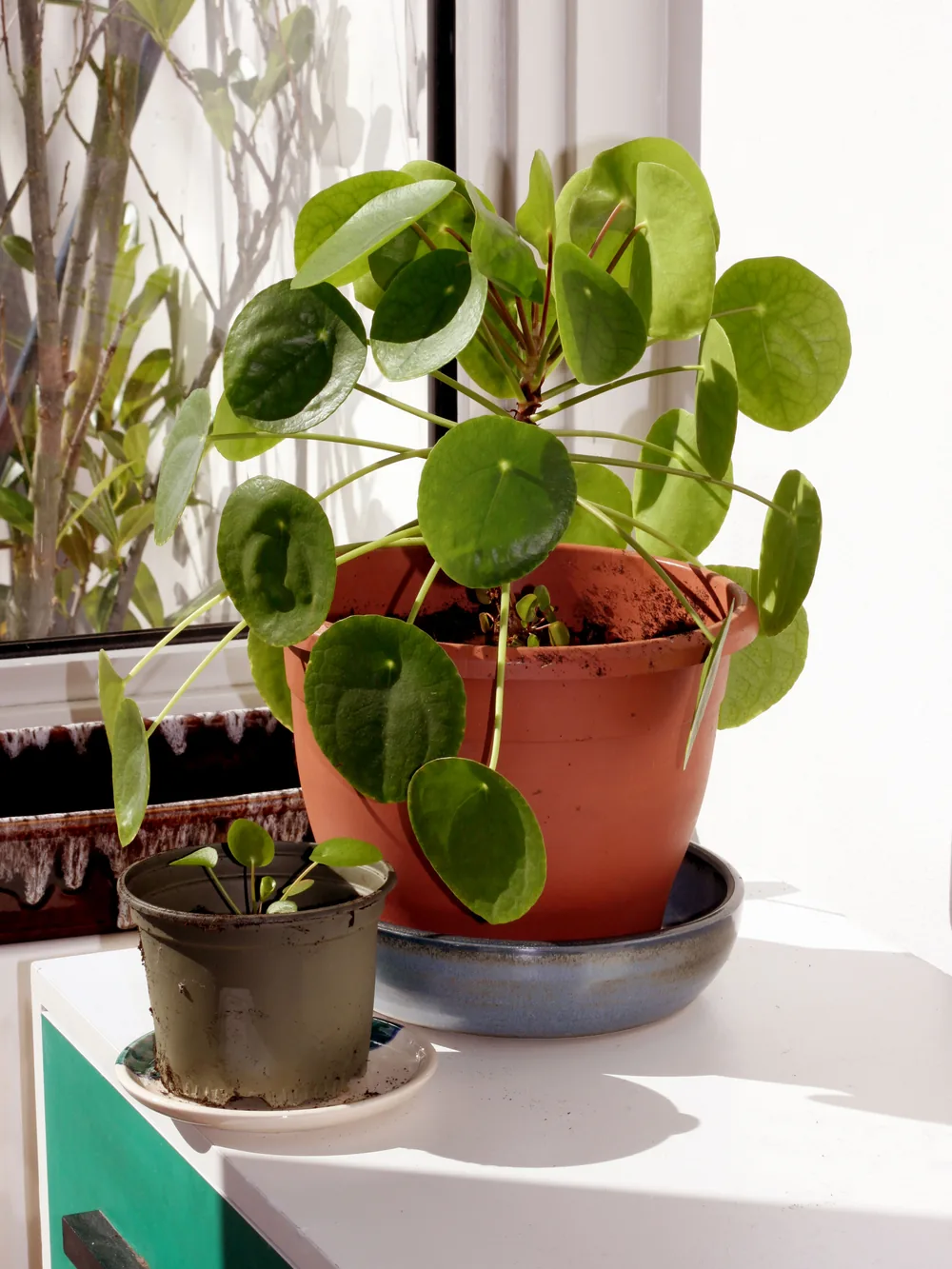
Chinese Money Plant (Pilea peperomioides)

Chinese Money Plant

Pilea peperomioides
Care level: Easy

Pilea peperomioides became known as the 'friendship plant' after a Norwegian missionary carried a cutting home from China in the 1940s, and it spread almost entirely through cuttings passed between friends and neighbors long before it was ever sold commercially.

I have this plant

Information

Varieties and related species
Pilea peperomioides 'Variegata'Pilea peperomioides 'Sugar'Pilea peperomioides 'Mojito'

Light

Prefers bright, indirect light; rotate regularly since it grows toward the light source.

Water

Water when the top 2-3cm of soil is dry, roughly every 1-2 weeks.

Humidity

Tolerates average home humidity well.

Soil

Well-draining, general-purpose potting mix.

Temperature

Normal room temperatures, away from cold draughts and heat sources.

Size

20-30cm tall and wide.

Growth speed

Fast

Best position

  • east / south-east-facing windowanywhere up to about 2 m from the window
  • north / north-east / north-west-facing windowanywhere up to about 1 m from the window
  • south / west-facing windowabout 1 m from the window or further back

Watch for strong direct sun at south / west windows.

See every window direction Hide window directions
Best positionright by the windowabout 1 mabout 2 mabout 4 m4 m or more
northworks wellworks welltoo darktoo darktoo dark
north-eastworks wellworks welltoo darktoo darktoo dark
eastworks wellworks wellworks welltoo darktoo dark
south-eastworks wellworks wellworks welltoo darktoo dark
southjust aboutworks wellworks welltoo darktoo dark
south-westjust aboutjust aboutworks welltoo darktoo dark
westjust aboutworks wellworks welltoo darktoo dark
north-westworks wellworks welltoo darktoo darktoo dark

works well just about too dark too much direct sun

A rough guide based on window direction and typical daylight through the year. Window size, curtains and whatever stands outside matter just as much.

Pet safety not confirmed

As a precaution, keep it out of reach of children and pets.

Propagation tip

Chinese money plants readily send up small plantlets from their base or roots. Once a pup has a few leaves of its own, it can be carefully separated with some roots attached and potted individually, or even rooted in water first.

Care by Season

Spring

Resume feeding monthly and remove baby offshoots to propagate if desired.

Summer

Water consistently and rotate the pot weekly for even, upright growth.

Autumn

Reduce watering slightly as growth slows.

Winter

Water sparingly and keep away from cold drafts and heating vents.

Growing & Maintenance

Soil and pot

General-purpose potting compost with some perlite or grit, in a pot with drainage holes. Terracotta suits it well because the compost dries out evenly.

Repotting

Every 1-2 years in spring, one pot size up.

Fertilising

A balanced liquid feed at half strength once a month in spring and summer. No feeding in winter.

Pruning

Little is needed: remove yellow lower leaves. A tall, leggy plant can be cut back in spring; the top roots as a cutting and the stump resprouts.

Propagation

From offsets. When a baby plant is 5-8cm tall, cut it from the mother plant with a clean knife 1-2cm below the soil, keeping some root, and pot it up. Offsets growing on the stem itself root in water.

Pests & Diseases

Common problems

Leaning to one side

Most likely cause: The plant grows toward its light source.
What to do: Turn the pot a quarter turn every week.

Leggy, stretched growth

Most likely cause: Too little light.
What to do: Move it to bright, indirect light.

Drooping, yellowing leaves

Most likely cause: Overwatering. The roots rot in wet compost.
What to do: Let the top 2-3cm dry before watering again. Trim rotten roots and repot in fresh, free-draining mix if needed.

Spots on the leaves

Most likely cause: Water left on the foliage.
What to do: Water the compost, not the leaves.

No baby plants

Most likely cause: Low light, or a plant that is still young.
What to do: Give it bright, indirect light and time.

Pests & Diseases

Spider mites

Signs: Fine webbing and stippled pale spots on leaves.
Treatment: Rinse leaves and increase humidity; apply insecticidal soap if needed. Check the undersides of the leaves and the crevices where the leaf stem meets the main stalk.

Mealybugs

Signs: White cottony clumps at stem joints.
Treatment: Dab with an alcohol-soaked cotton swab weekly until resolved. Check the undersides of the leaves and the crevices where the leaf stem meets the main stalk.

Root rot

Signs: Drooping, yellowing leaves and mushy roots from overwatering.
Treatment: Repot into fresh, well-draining soil after trimming away rotten roots.

FAQ

Why is my Chinese money plant leaning or growing sideways?

Because it grows toward the light. Turn the pot a quarter turn every week or so and the plant grows evenly and stays upright.

Why won't my Chinese money plant produce babies?

Usually because of low light or because the plant is still young. Give it bright, indirect light and some patience, and plantlets will appear at the base.

How often should I water a Chinese money plant?

About every 1-2 weeks, when the top 2-3cm of compost is dry. It likes moist, well-drained compost but is prone to root rot if overwatered.

How do I propagate a Chinese money plant?

Separate the baby plants that grow at its base. Cut one free with some root attached and pot it up, ideally in spring or early summer. Stem cuttings root too.

Does a Chinese money plant flower?

Rarely indoors. It can produce small white to pinkish flowers on tall spikes, but houseplants seldom do. It is grown for its round leaves.

How much light does a Chinese money plant need?

It needs bright, indirect light. In too little light the growth becomes leggy and fewer plantlets form.

You might also like