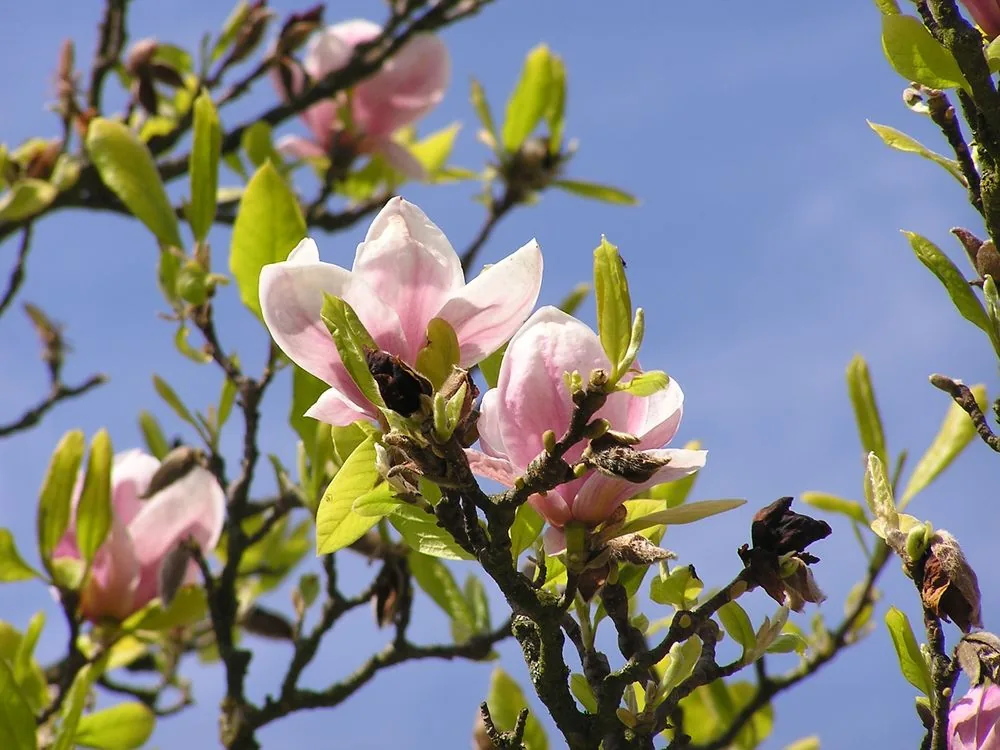
Large pink and white goblet-shaped magnolia flowers on bare branches against a blue sky

Magnolia

Magnolia x soulangeana
Care level: Easy

The saucer magnolia is the magnolia of front gardens: a wide-spreading deciduous tree or large shrub that covers its bare branches in mid-spring with goblet-shaped flowers up to 25cm across, white inside and flushed pink to purple outside. It is a hybrid raised in France in the 1820s from two Chinese species. The flowers open before and with the young leaves, which then form a dense canopy of large, dark green ovals. It is hardy, long-lived and needs almost no pruning, but it becomes as wide as it is tall, so it needs room.

I have this plant

Information

Varieties and related species
Magnolia x soulangeana 'Lennei'Magnolia x soulangeana 'Alba Superba'Magnolia stellata

Light

Full sun or partial shade, with shelter from cold winds and late frost.

Water

Water regularly for the first two or three years and in summer droughts after that. Dry soil in late summer reduces next year's flowers.

Humidity

Not a factor for this outdoor tree.

Soil

Moist but well-drained, neutral to acid soil rich in organic matter. It dislikes shallow chalk and waterlogged ground.

Size

4-8m tall and 4-8m wide.

Growth speed

Medium

Hardiness

Hardy down to about -20°C. Source: RHS

Pet safety not confirmed

As a precaution, keep it out of reach of children and pets.

Common mistake

Do not dig or plant under it. Magnolias have thick, fleshy roots that lie close to the surface and are easily damaged, and a tree with broken roots sulks for years. Keep the ground beneath it undisturbed, mulch it each spring and plant bulbs or ground cover only while the tree is young.

Care by Season

Spring

Flowers open in mid-spring. Mulch with composted bark or leaf mould.

Summer

In full leaf. Water in dry spells and do any pruning from midsummer.

Autumn

Leaves turn yellow-brown and fall. Next year's furry flower buds are already visible.

Winter

Bare, with silky grey buds on the branch tips. Plant new trees in mild weather.

Growing & Maintenance

Planting

Plant in autumn or spring in a sheltered position, no deeper than it was in the pot, in soil improved with leaf mould or composted bark. Stake for the first two years and give it space to spread.

Fertilising

Mulch each spring. On poor soil, apply a general or ericaceous fertiliser in spring.

Pruning

Minimal. Remove dead, damaged or crossing branches between midsummer and early autumn only.

Propagation

By softwood cuttings in late spring and early summer or semi-ripe cuttings in late summer. Seed does not come true from this hybrid.

Pests & Diseases

Common problems

Brown, limp flowers

Most likely cause: Frost on the open blooms.
What to do: Give shelter; the tree flowers normally the following year.

Yellow leaves with green veins

Most likely cause: Alkaline soil.
What to do: Mulch with acid organic matter and use an ericaceous feed.

Few or no flowers

Most likely cause: Shade, drought the previous summer or a young, recently moved tree.
What to do: Water in late summer and give it more light.

Upright, whippy shoots after pruning

Most likely cause: Hard pruning.
What to do: Thin them over several summers instead of cutting everything back.

Slow growth after planting

Most likely cause: Root disturbance.
What to do: Mulch, water and be patient.

Leaves scorched at the edges

Most likely cause: Drought or drying wind.
What to do: Water deeply and mulch.

Pests & Diseases

Scale insects

Signs: Brown, shell-like bumps or white, waxy egg masses on the bark and under the leaves, with sticky honeydew and black sooty mould.
Treatment: Scrub them off young trees with a soft brush and soapy water in winter. Large trees tolerate them.

Capsid bugs

Signs: Small, ragged holes and distortion in the young leaves at the shoot tips.
Treatment: No treatment is needed; the damage is cosmetic.

Coral spot

Signs: Branches die back and carry small, coral-pink pustules on the dead bark.
Treatment: Cut affected branches back to healthy wood in dry summer weather and dispose of them.

Fungal leaf spot

Signs: Dark spots on the leaves in wet summers.
Treatment: Rake up and dispose of fallen leaves in autumn.

FAQ

Why did the flowers turn brown?

Frost. The buds and open flowers are damaged by a late frost, especially when morning sun thaws them quickly. The tree itself is unharmed and flowers again next year. Plant it in a spot sheltered from cold winds and out of frost pockets, ideally not facing east.

When does a magnolia start flowering?

A saucer magnolia bought from a nursery is grown from cuttings or grafts and usually flowers within two to three years of planting, often while still under a metre tall.

When and how should I prune it?

As little as possible, and only between midsummer and early autumn. Cuts made in winter or spring bleed sap and heal slowly. Remove dead, damaged or crossing branches, and never shorten all the shoots, which spoils the shape and triggers a thicket of upright growth.

Why are the leaves yellow with green veins?

The soil is too alkaline, so the tree cannot take up iron. Magnolias want neutral to acid soil. Mulch with composted bark or leaf mould, water with rainwater in dry spells and apply a feed for acid-loving plants.

Can I move an established magnolia?

It is risky. The fleshy roots break easily and regrow slowly. If it has to move, do it in spring as growth begins, with as large a root ball as possible, and water it through the following two summers.

Can I grow it in a pot?

Only for a few years. It grows into a broad tree and resents root restriction. For a pot or a small garden, the star magnolia, Magnolia stellata, is a better choice.

Why are there few flowers?

The tree may still be settling in, it may be in too much shade, or the buds were lost to frost or summer drought. Flower buds form in late summer, so water in dry spells at that time.

You might also like