No results. Is a plant missing? Tell uscontact@wikiplant.net
Rhubarb
Rheum rhabarbarum
Care level: Easy
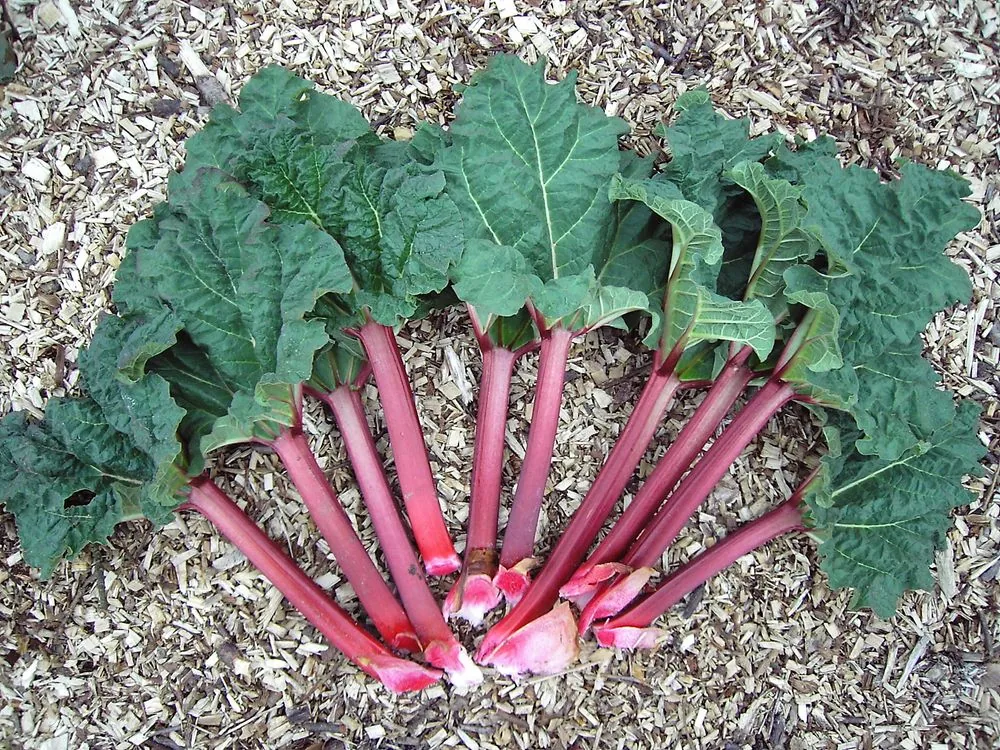
Rhubarb is a long-lived perennial vegetable grown for its sharp, pink to red leaf stalks, which are cooked and sweetened like fruit. A crown planted once in rich, moist soil crops every spring for ten years or more with almost no attention, pushing up huge crinkled leaves from fat buds at soil level. It is fully hardy and in fact needs a cold winter to rest. Only the stalks are eaten; the leaves are poisonous to people and pets.
Rheum x hybridum 'Timperley Early'Rheum x hybridum 'Victoria'Rheum x hybridum 'Champagne'
Light
Full sun; it tolerates light shade.
Water
Keep the soil moist. Water well in dry spells in summer, especially in the first year.
Humidity
Not a factor for this outdoor plant.
Soil
Deep, fertile, moisture-holding soil that does not lie wet in winter, enriched with plenty of garden compost or well-rotted manure.
Temperature
Fully hardy. The crowns need a cold winter to rest and crop well.
Size
0.6-1.2m tall and 0.9-1.2m wide.
Growth speed
Fast
!Toxic to pets
Toxic to cats and dogs if eaten.
The leaves contain soluble oxalates. Eating them causes drooling and vomiting, then weakness, tremors and kidney injury.
If your pet has eaten some, contact your vet.
Source: NC State Extension, Pet Poison Helpline
Safety note
Eat the stalks only. The leaf blades contain oxalic acid and soluble oxalates and are poisonous to people, cats and dogs, so cut them off at harvest and put them on the compost heap, where they break down safely.
Care by Season
Spring
Stalks push up and the harvest begins. Pull stalks as needed and remove any flower stalks.
Summer
Stop picking by midsummer. Water in dry weather and let the leaves build up the crown.
Autumn
The leaves die back. Clear them away and mulch around, not over, the crown.
Winter
The crown is dormant and needs the cold. Plant or divide crowns, and cover one for forcing in late winter.
Growing & Maintenance
Planting
Plant dormant crowns between autumn and early spring, 75-90cm apart, with the bud just at or slightly above soil level. Dig in plenty of garden compost first. Buried crowns tend to rot.
Fertilising
Mulch each spring with garden compost or well-rotted manure, keeping it off the crown, and add a general fertiliser.
Pruning
Remove flower stalks as they appear and clear away the dead leaves in autumn.
Propagation
Divide crowns every five years or so while dormant. Split them with a spade into pieces that each have a healthy bud and a good section of root, and replant the outer, younger pieces.
Pests & Diseases
Common problems
Thin, weak stalks
Most likely cause: An old, congested crown, hungry soil or over-picking.
What to do: Divide the crown in winter, mulch generously and pick less.
Flower stalks appear
Most likely cause: A mature or stressed plant, often after a dry spell.
What to do: Cut them out at the base at once.
Crown soft and brown
Most likely cause: Crown rot, usually in wet soil or where the crown was planted too deep.
What to do: Remove it and replant fresh stock elsewhere.
Stalks stay green
Most likely cause: The variety; many are green with only a red flush.
What to do: Nothing is wrong. Flavour does not depend on colour.
Leaves wilt in summer
Most likely cause: Dry soil.
What to do: Water deeply and mulch to hold moisture.
Pests & Diseases
Crown rot
Signs: Buds and the base of the stalks turn brown and soft, and growth is weak and spindly.
Treatment: Dig out and remove the rotten parts or the whole plant, and replant fresh crowns in a new, better-drained spot.
Slugs and snails
Signs: Ragged holes in young leaves and scraped stalks in spring.
Treatment: Pick them off in the evening and clear hiding places around the crown.
Leaf spot
Signs: Brown spots on the leaves, some with a red edge, that fall out to leave holes.
Treatment: It rarely affects the crop. Remove badly marked leaves and clear all foliage in autumn.
FAQ
Are rhubarb leaves poisonous?
Yes. The leaf blades are poisonous to people and to pets and must never be eaten. Only the stalks are used, and they are safe once the leaf is trimmed off.
When can I start harvesting a new plant?
Do not pick at all in the first year, and take only a few stalks in the second. From the third year harvest freely in spring and early summer.
Should I cut or pull the stalks?
Pull them. Hold the stalk low down, then twist and pull so that it comes away cleanly from the crown. Cut stumps are left to rot.
When should I stop picking?
By midsummer. After that leave the plant alone so the leaves can feed the crown for next year. Never take more than about half the stalks at once.
What do I do when it flowers?
Cut the thick flower stalk off at the base as soon as you see it. Flowering weakens the crown and reduces next year's crop.
What is forced rhubarb?
Stalks grown in the dark. Cover an established crown in late winter with a tall pot or forcing jar to shut out the light; pale, tender, sweeter stalks are ready a few weeks earlier. Give that crown a year off afterwards.
Can I grow rhubarb in a pot?
Only in a very large one, at least 50cm deep and wide, with regular watering and feeding. It crops far better in the ground.