No results. Is a plant missing? Tell uscontact@wikiplant.net
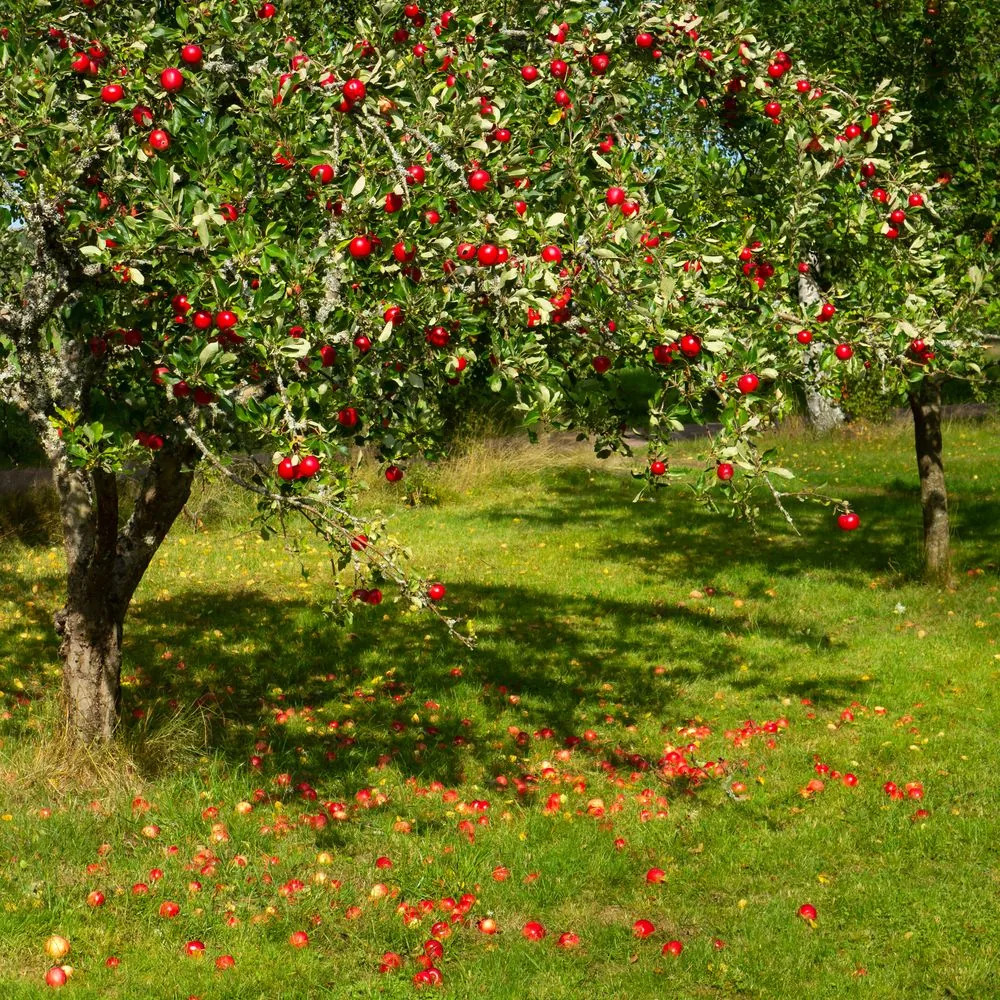
The apple is the most widely grown fruit tree of temperate climates: a deciduous tree with white, pink-flushed blossom in spring and fruit that ripens, depending on the variety, from late summer to late autumn. Every apple tree you buy is two plants joined together, a named variety grafted onto a rootstock that decides how big the tree will grow. That makes it possible to fit an apple into almost any garden, as a full-sized standard, a small bush, a row of cordons along a fence or a tree in a large pot. It needs sun, shelter and deep, moist, well-drained soil.
I have this plantSign in to add this plant to your library
As a precaution, keep it out of reach of children and pets.
Choose the rootstock before the variety. The rootstock sets the final size of the tree: very dwarfing ones give a tree of under 2m for pots and cordons, semi-dwarfing ones a garden bush of 3-4m, vigorous ones a large orchard tree. The label names it, for example M27, M9, M26, MM106 or M25, from smallest to largest.
Usually, yes. Most apples do not set fruit with their own pollen and need a different variety flowering at the same time within bee range. A neighbour's tree or a crab apple does the job. A few varieties are partly self-fertile but still crop better with a partner.
Prune free-standing trees in winter, while dormant: remove dead, diseased and crossing branches and keep the centre open to light and air. Trained forms such as cordons, espaliers and fans are pruned in late summer, shortening the new side shoots, which keeps them compact and fruitful.
Two to four years on a dwarfing rootstock, and five years or more on a vigorous one. Remove the blossom in the first year so that the tree puts its energy into roots.
That is the natural thinning known as the June drop. The tree sheds fruitlets it cannot carry. Afterwards, thin what remains to one or two fruits per cluster, about a hand's width apart, for larger, better apples and a crop every year.
Codling moth caterpillars, which tunnel to the core and leave a hole plugged with brown droppings. Hang pheromone traps in late spring to catch the male moths and pick up and remove fallen fruit.
It will grow, but it will not resemble its parent, may take ten years to fruit and makes a large tree. For a known variety on a known rootstock, buy a grafted tree.
Yes, on a dwarfing rootstock, in a container of at least 45cm with loam-based compost. Water regularly, feed in spring and summer and repot or top-dress every year or two.