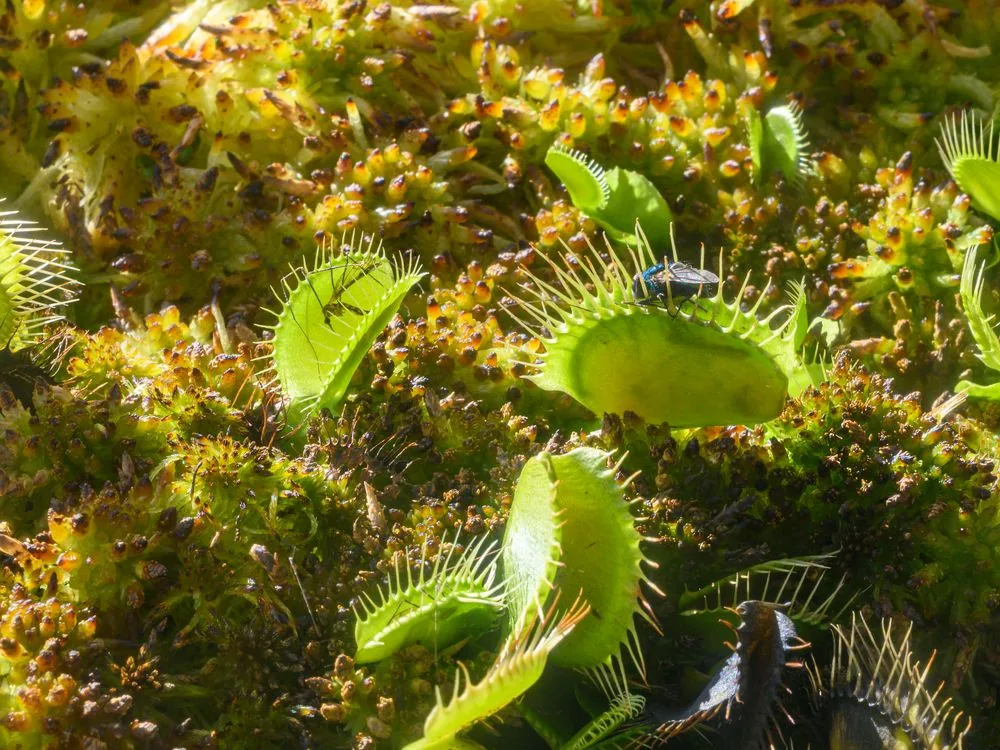
Open green Venus flytrap traps with toothed edges growing among moss

Venus flytrap

Dionaea muscipula
Care level: Moderate

The Venus flytrap is a small carnivorous plant from the wet, sandy bogs of North and South Carolina. It grows as a low rosette of leaves, each a flat green stalk ending in a hinged trap edged with teeth. When an insect brushes the fine trigger hairs inside twice in quick succession, the trap snaps shut in a fraction of a second, seals and digests its catch over a week or more. It is not a difficult plant, but its needs are the reverse of most houseplants: full sun, permanently wet, pure water, poor soil and a cold winter rest.

I have this plant

Information

Varieties and related species
Dionaea muscipula 'Akai Ryu'Dionaea muscipula 'B52'Drosera capensis

Light

Full sun: at least four to six hours of direct sun a day. Indoors, the sunniest windowsill there is.

Water

Keep the soil wet in the growing season by standing the pot in 1-2cm of rainwater or distilled water. Keep it just damp in winter. Never use tap water.

Humidity

It likes humid air but does not need a closed terrarium, which overheats in sun and encourages mould.

Soil

A nutrient-poor, acidic carnivorous plant mix. No ordinary compost, no fertiliser, no lime.

Size

A rosette 10-30cm across; each trap is about 2cm long.

Growth speed

Slow

Hardiness

Hardy down to about -5°C. Source: RHS

Pet safety not confirmed

As a precaution, keep it out of reach of children and pets.

Common mistake

Never use tap water and never fertilise. The plant comes from mineral-poor bogs, and the salts in tap water, bottled mineral water and plant food build up in the soil and kill the roots within months. Water only with rainwater, distilled or deionised water, and let the plant catch its own food.

Care by Season

Spring

Growth resumes. Repot into fresh mix if needed, cut off flower stalks on small plants and stand the pot in water again.

Summer

The largest traps of the year form. Keep it in full sun and standing in pure water.

Autumn

Growth slows and traps blacken. Reduce the water in the saucer.

Winter

Dormant. Keep it cold, bright and just damp, and remove black leaves to prevent mould.

Growing & Maintenance

Repotting

Repot every one or two years in late winter or early spring, before growth starts, into fresh carnivorous plant mix in a plastic pot at least 10cm deep.

Pruning

Cut off traps and leaves once they are completely black. Remove the flower stalk on young plants.

Propagation

By division in early spring, separating the offsets that form around the main rosette, or by seed, which takes several years to reach full size.

Pests & Diseases

Common problems

Many traps blacken at once

Most likely cause: Tap water, fertiliser or overfeeding.
What to do: Flush the pot with rainwater, repot into fresh mix and stop feeding.

Traps do not close

Most likely cause: A weak plant, too little light or cold weather.
What to do: Give full sun and pure water; the next traps will work.

Long, thin leaves with small traps

Most likely cause: Too little light.
What to do: Move it to full sun.

The plant shrinks each year

Most likely cause: No cold winter rest.
What to do: Give three to four months at around 0-10°C.

Mould in winter

Most likely cause: Stagnant, damp air on dead leaves.
What to do: Trim black leaves and ventilate.

The whole plant collapses

Most likely cause: The soil dried out, or the roots were poisoned by minerals.
What to do: Stand it in rainwater at once and repot into fresh carnivorous mix.

Pests & Diseases

Aphids

Signs: Twisted, deformed new traps with tiny insects in the centre of the rosette.
Treatment: Submerge the whole pot in rainwater for a day or two to drown them, or pick them off with tweezers.

Mealybugs

Signs: White, woolly tufts at the base of the leaves.
Treatment: Dab them off with a cotton bud dipped in alcohol and repeat weekly. Check the undersides of the leaves and the crevices where the leaf stem meets the main stalk.

Grey mould

Signs: Fluffy grey mould on dead leaves and traps in winter, spreading into the crown.
Treatment: Remove dead material promptly, give more air and keep the soil only just damp while dormant.

FAQ

What water should I use?

Rainwater, distilled water or deionised water only. Stand the pot in a saucer with 1-2cm of water throughout the growing season, so that the soil never dries out.

Do I need to feed it?

No. Outdoors or on an open windowsill it catches all it needs. If it is kept where there are no insects, give one trap a small live or freshly killed insect every few weeks. Never feed it meat, cheese or anything larger than a third of the trap, which makes the trap rot.

Why are the traps turning black?

Each trap works only a few times, then blackens and dies while new ones grow from the centre. That is normal. Many traps blackening at once points to tap water, fertiliser, traps triggered too often or food that was too large.

Can I make the traps close with my finger?

Try not to. Closing costs the plant a great deal of energy, and a trap that closes on nothing reopens after a day or so having gained nothing. A trap closes only a handful of times in its life.

Why does it look dead in winter?

It is resting. From late autumn the leaves die back to a small, tight rosette or disappear, and the plant needs three to four months of cold, around 0-10°C, in a bright, unheated room, cold frame or sheltered spot outdoors. Keep the soil just damp. A flytrap kept warm all winter weakens and usually dies within a couple of years.

Should I let it flower?

On a small or newly bought plant, cut the flower stalk off as soon as it appears in spring. Flowering takes energy that the plant would otherwise put into traps. Strong, established plants can be left to flower.

What soil does it need?

A nutrient-poor, acidic mix made for carnivorous plants, such as moss peat substitute or sphagnum mixed with lime-free sand or perlite. Ordinary potting compost contains fertiliser and lime and will kill it.

You might also like