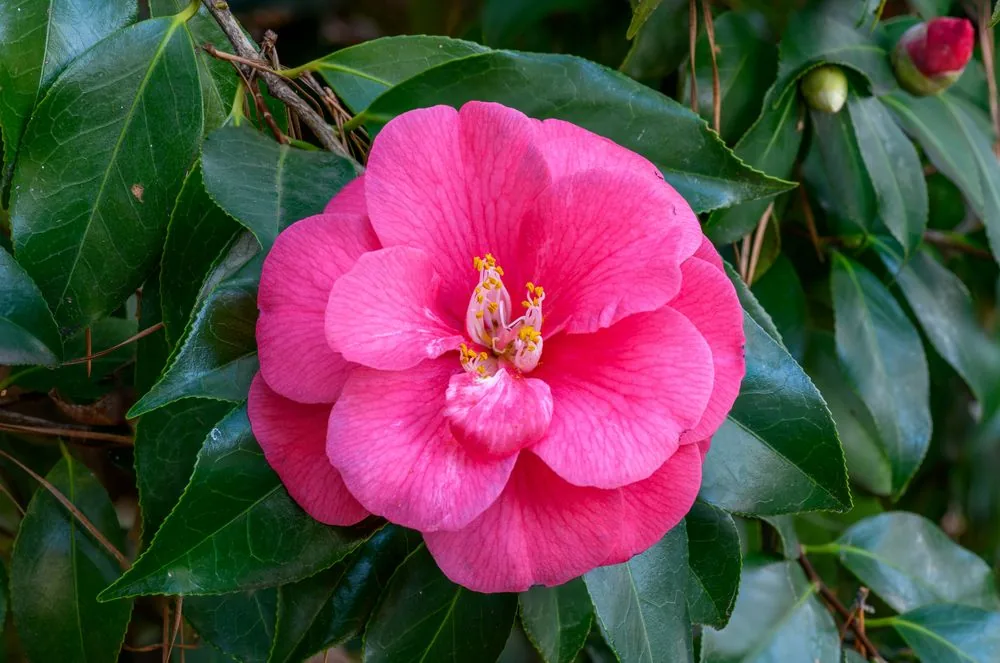
A bright pink camellia flower with yellow stamens among glossy, dark green leaves

Camellia

Camellia japonica
Care level: Moderate

The Japanese camellia is an evergreen shrub from the woodlands of China, Korea and Japan, grown for its glossy, dark green leaves and its large flowers in late winter and spring, when little else is in bloom. The flowers are white, pink or red, 6-10cm across, and range from single with a boss of yellow stamens to fully double like a formal rose. It is a relative of the tea plant and, like it, needs acid soil. In the right spot, sheltered and lightly shaded, it is long-lived and needs little attention, and it grows well in a large pot.

I have this plant

Information

Varieties and related species
Camellia japonica 'Adolphe Audusson'Camellia japonica 'Nobilissima'Camellia x williamsii 'Donation'

Light

Partial or dappled shade, out of early morning sun. It tolerates full sun only in moist soil.

Water

Keep the soil moist, especially from midsummer to autumn. Use rainwater where tap water is hard.

Humidity

Not a factor for this outdoor shrub.

Soil

Moist but well-drained, acid soil rich in organic matter. In pots, peat-free ericaceous compost.

Size

Usually 2-4m tall in gardens; very old plants can reach 6m or more.

Growth speed

Slow

Hardiness

Hardy down to about -15°C. Source: RHS

Pet safety not confirmed

As a precaution, keep it out of reach of children and pets.

Common mistake

Water it in late summer, not just in spring. Next year's flower buds form between midsummer and early autumn, and a plant that dries out then drops its buds months later, in winter, just before they should open. This is the commonest reason a healthy camellia does not flower, above all in a pot.

Care by Season

Spring

Flowers. Prune lightly straight afterwards, feed with an ericaceous fertiliser and mulch.

Summer

New growth hardens and next year's buds form. Water regularly; this is the critical time.

Autumn

Keep watering in dry spells. Plant new camellias.

Winter

Buds swell and early varieties open. Protect pots and opening flowers from hard frost.

Growing & Maintenance

Planting

Plant in autumn or spring with the top of the root ball level with the soil surface, never deeper, in a sheltered, lightly shaded position. Mulch with composted bark or leaf mould.

Fertilising

Feed in spring and again in early summer with a fertiliser for acid-loving plants. Do not feed after midsummer, which can cause bud drop.

Pruning

Prune lightly after flowering. Remove dead, weak and straggly shoots; renovate old plants in stages.

Propagation

By semi-hardwood cuttings in late summer, rooted in a covered propagator with gentle warmth, or by layering low branches.

Pests & Diseases

Common problems

Buds drop unopened

Most likely cause: Drought the previous summer, hard frost or waterlogging.
What to do: Water from midsummer to autumn and protect pots in hard frost.

Yellow leaves with green veins

Most likely cause: Alkaline soil or hard water.
What to do: Use ericaceous compost and feed, and water with rainwater.

Brown flowers

Most likely cause: Frost thawed by morning sun, or petal blight.
What to do: Move out of morning sun and clear fallen flowers.

Black, sooty leaves

Most likely cause: Honeydew from scale insects or aphids.
What to do: Clean the leaves and remove the insects.

Brown, scorched leaf patches

Most likely cause: Hot sun or cold, drying wind.
What to do: Give shade and shelter.

No flower buds

Most likely cause: Deep shade, late pruning or feeding after midsummer.
What to do: Give more light, prune straight after flowering and stop feeding in midsummer.

Pests & Diseases

Scale insects

Signs: Flat, oval scales and white, waxy egg bands under the leaves, with sticky honeydew and black sooty mould on the leaves below.
Treatment: Wipe them off with a damp cloth, wash off the sooty mould and repeat in early summer when the young hatch.

Vine weevil

Signs: Notches bitten from the leaf edges; in pots, white grubs eat the roots and the plant wilts and dies.
Treatment: Check pots for grubs when repotting and apply a nematode drench in late summer.

Aphids

Signs: Clusters of small insects on the soft new shoots in spring.
Treatment: Rub or rinse them off.

Camellia petal blight

Signs: Brown patches spreading from the centre of the flower until the whole bloom is brown and falls.
Treatment: Pick up and bin every fallen flower and renew the mulch under the plant.

Camellia gall

Signs: Pale, swollen, fleshy growths in place of leaves, later coated in white powder.
Treatment: Cut the galls off and bin them before they turn white.

FAQ

Why are the buds falling off before they open?

Usually the plant was too dry the previous summer, when the buds were forming. Sudden hard frost, waterlogging and moving a pot in bud can also cause it. Water thoroughly in dry spells from midsummer to autumn, with rainwater if you can.

Why are the leaves turning yellow?

Yellow leaves with green veins mean the soil or water is too alkaline, so the plant cannot take up iron. Use ericaceous compost in pots, water with rainwater and apply a feed for acid-loving plants in spring. A few old leaves yellowing and dropping in spring is normal.

Where is the best place to plant it?

In partial shade, sheltered from cold, drying winds, in moist, acid soil. Avoid a spot that catches early morning sun: frozen buds and flowers that thaw quickly in sun turn brown.

Why are the flowers brown?

Frost damage followed by a fast thaw, or camellia petal blight, a fungus that turns the petals brown from the centre and makes the whole flower fall. Pick up and bin all fallen flowers if you suspect blight.

When should I prune a camellia?

Straight after flowering, in spring, before the new growth has hardened. It needs little: shorten straggly shoots and remove dead wood. An overgrown plant can be cut back hard in stages, over two or three years.

Can I grow it in a pot?

Yes. Use a pot at least 40cm wide with ericaceous compost, stand it in light shade, water with rainwater and never let it dry out in summer. In hard frost, wrap the pot, since the roots are less hardy than the top.

What is the black coating on the leaves?

Sooty mould, growing on the sticky honeydew dropped by scale insects or aphids feeding on the undersides of the leaves above. Wipe the leaves clean and deal with the insects.

You might also like