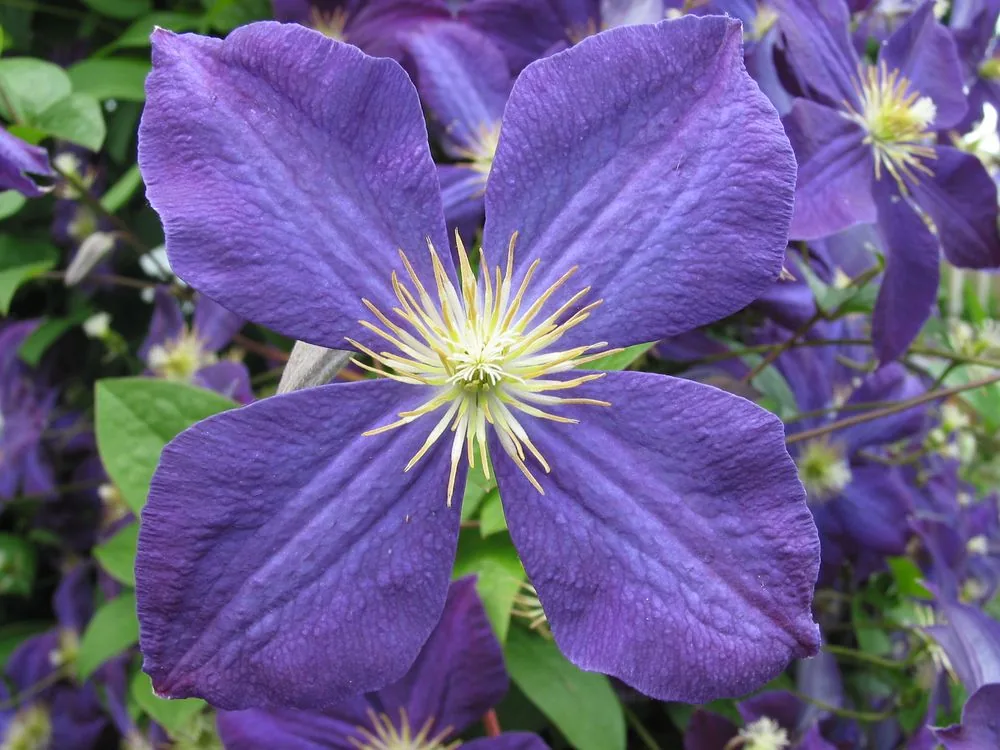
Large, deep purple clematis flowers with pale centres covering a climbing plant

Clematis

Clematis spp.
Care level: Moderate

Clematis is a large group of climbers in the buttercup family, with a kind in flower for almost every month of the year. They range from rampant species that smother a wall in small white or pink flowers in spring to large-flowered hybrids with blooms the size of a saucer in summer, and late kinds with small bells or nodding lanterns into autumn. They climb by twisting their leaf stalks around anything thin enough to grip. Most are hardy and long-lived. The one thing a gardener needs to know is which of the three pruning groups a plant belongs to.

I have this plant

Information

Varieties and related species
Clematis montanaClematis 'Jackmanii'Clematis 'Nelly Moser'

Light

Sun or partial shade for the top growth, with the base of the plant shaded.

Water

Water regularly in the first two years and deeply in dry spells afterwards. Dry roots lead to poor flowering and mildew.

Humidity

Not a factor for this outdoor plant.

Soil

Fertile, moisture-retentive but well-drained soil. Improve it with garden compost before planting.

Temperature

Most garden clematis are fully hardy. Evergreen kinds such as Clematis armandii need a sheltered, sunny wall.

Size

Compact kinds 1-2m; large-flowered hybrids 2-4m; vigorous species such as Clematis montana 8m or more.

Growth speed

Fast

Toxic to pets

Toxic to cats and dogs if eaten.

Eating it can cause vomiting and an upset stomach.

If your pet has eaten some, contact your vet.

Source: NC State Extension, Pet Poison Helpline

Did you know?

Pruning depends on when the plant flowers. Group 1 flowers in spring on last year's stems and is only tidied after flowering. Group 2, the large-flowered hybrids of early summer, is trimmed lightly in late winter. Group 3 flowers from midsummer on new growth and is cut down to 15-30cm in late winter. The plant label states the group.

Care by Season

Spring

Early kinds flower. Tie in new shoots, mulch and feed. Prune group 1 plants after flowering if they need it.

Summer

Large-flowered and late kinds flower. Water in dry spells and trim group 2 plants after their first flush.

Autumn

Late kinds finish, leaving silky seed heads. Plant new clematis.

Winter

In late winter, trim group 2 plants lightly and cut group 3 plants down to 15-30cm.

Growing & Maintenance

Planting

Plant in autumn or spring, 30-45cm out from a wall or fence, and lead the stems to the support with a cane. Set large-flowered hybrids 5-8cm deeper than they were in the pot.

Fertilising

Mulch with garden compost or well-rotted manure in late winter and apply a fertiliser high in potash, such as a rose feed, in spring.

Pruning

Follow the pruning group. In the first spring after planting, cut any clematis back to about 30cm to make it branch from the base.

Support

Fix horizontal wires or netting to walls and fences and tie in the new shoots, spreading them out. Guide them back in while they are young; old stems are brittle.

Propagation

By layering a low stem in spring, or by softwood or semi-ripe cuttings taken between the leaf joints in late spring and summer.

Pests & Diseases

Common problems

No flowers

Most likely cause: Pruned at the wrong time, too much shade or a young plant.
What to do: Check the pruning group and give the top growth more light.

Flowers only at the top, bare stems below

Most likely cause: Not pruned, or pruned too lightly, for its group.
What to do: Cut group 3 plants hard each year and train the stems sideways.

Sudden wilting

Most likely cause: Clematis wilt, or a stem broken or kinked at the base.
What to do: Cut back to healthy growth; check the stems for damage.

Yellow leaves

Most likely cause: Drought, waterlogging or a shortage of nutrients.
What to do: Water regularly, improve the drainage and feed in spring.

Faded flower colour

Most likely cause: Strong sun on pale-flowered varieties.
What to do: Grow them on a north-, east- or west-facing wall.

Tangled mass of stems

Most likely cause: A vigorous species left unpruned for years.
What to do: Cut it back hard after flowering, to within a metre of the base; it will regrow.

Pests & Diseases

Clematis wilt

Signs: Shoots wilt suddenly and turn black, often just as the flower buds open; mostly on large-flowered hybrids.
Treatment: Cut affected stems back to healthy growth or to the ground and bin them. Plant deep so that the plant can reshoot.

Powdery mildew

Signs: A white, powdery coating on the leaves and flowers in late summer, mostly on plants dry at the root.
Treatment: Water deeply, mulch and thin congested growth.

Slugs and snails

Signs: New shoots eaten off at ground level in spring and the bark stripped from young stems.
Treatment: Hand-pick after dark and protect the base of young plants.

Earwigs

Signs: Ragged holes in the petals and young leaves, appearing overnight.
Treatment: Trap them in upturned pots stuffed with straw and empty these each morning.

Aphids

Signs: Clusters of small insects on the shoot tips and flower buds in spring.
Treatment: Rub or rinse them off; predators usually follow.

FAQ

How do I know which pruning group mine is in?

Go by flowering time. Flowers in spring: group 1, no regular pruning. Large flowers in early summer, often with a second flush later: group 2, a light trim in late winter back to a pair of strong buds. Flowers from midsummer onwards: group 3, cut hard in late winter. If you do not know, leave it a year and watch.

Why did my clematis suddenly collapse?

Clematis wilt, a fungal disease that mostly strikes large-flowered hybrids. Stems wilt and blacken within days. Cut all affected growth back to healthy tissue, to ground level if necessary; a plant set deep usually reshoots from below the soil.

How deep should I plant it?

Plant large-flowered hybrids with the top of the root ball 5-8cm below the soil surface. The buried stems make new shoots if the top is lost to wilt or damage. Species and small-flowered kinds are planted level with the soil.

What does 'feet in the shade, head in the sun' mean?

Clematis flower best with their top growth in light but want cool, moist roots. Shade the base with low plants, a thick mulch or a few flat stones, and water deeply in dry spells.

What support does it need?

Something thin. The leaf stalks cannot grip posts or thick trellis bars, so fix wires, netting or mesh to walls and fences, and tie in young shoots until they catch. Clematis also climb well through shrubs and roses.

Can I grow clematis in a pot?

Yes, if you choose a compact variety and a pot at least 45cm deep and wide, with loam-based compost and an obelisk for support. Water regularly, feed in spring and summer and keep the pot shaded.

Why are the flowers green or misshapen?

Cold weather while the buds form gives green-tinged early flowers on some large-flowered hybrids; later flowers come normal. Ragged holes in the petals are usually the work of earwigs at night.

You might also like