No results. Is a plant missing? Tell uscontact@wikiplant.net
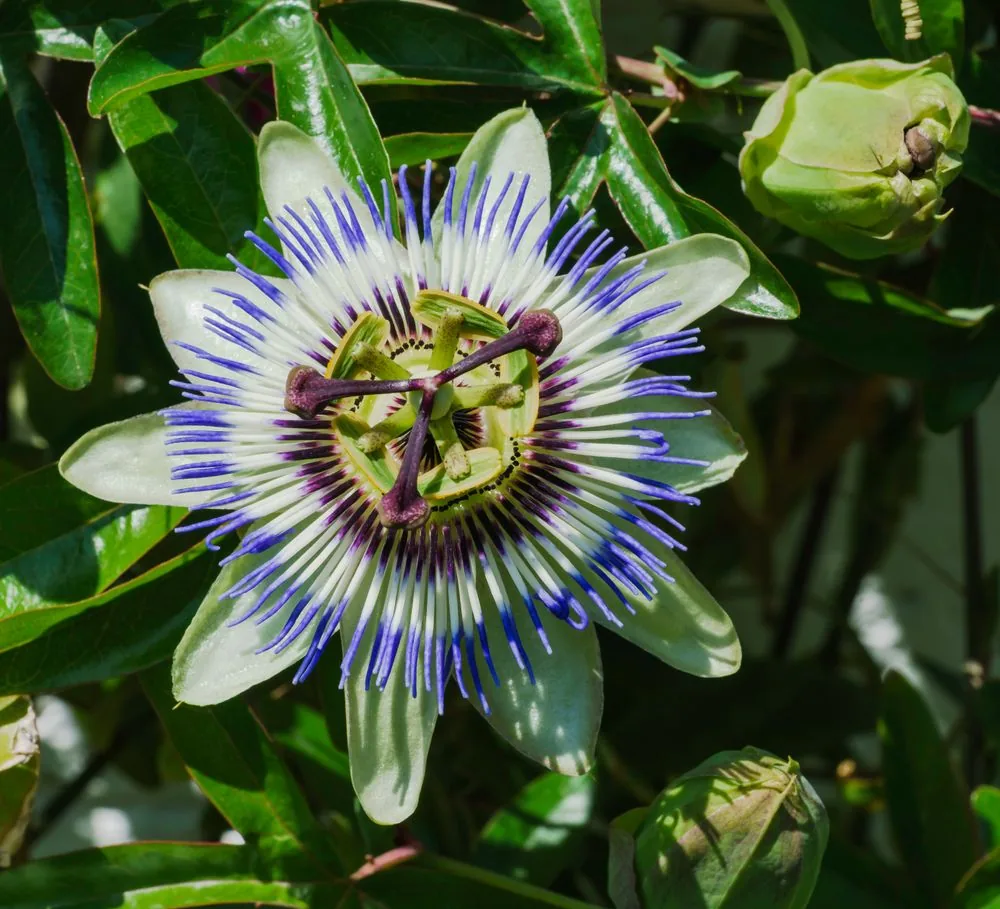
The blue passion flower is a fast, evergreen to semi-evergreen climber from South America and the hardiest of its large tropical family. Its flowers look engineered: ten white petals, a ring of filaments banded in blue, white and purple, and a raised centre of five green anthers and three dark stigmas. They open from summer into autumn and are followed in warm years by orange, egg-shaped fruits. It climbs by tendrils on wires or trellis against a warm, sheltered wall and regrows from the base if a hard winter cuts it down.
I have this plantSign in to add this plant to your library
Toxic to cats and dogs if eaten.
Can cause vomiting and diarrhoea, and more rarely affects heart rhythm.
If your pet has eaten some, contact your vet.
Source: NC State Extension
Each flower lasts only about a day, but a healthy plant on a sunny wall opens new ones daily from midsummer to early autumn. The ring of coloured filaments, the corona, is what sets passion flowers apart from every other climber.
Hardy enough for a sheltered wall in mild regions, down to about -5 to -10°C. In a hard winter the top growth can be killed, but an established plant usually shoots again from the base in spring. Mulch the roots in autumn.
The orange fruits are edible when fully ripe, but they are seedy and bland. Unripe fruits can upset the stomach. The passion fruit sold in shops comes from another species, Passiflora edulis, which needs warmth under glass.
The usual causes are shade, rich soil or heavy feeding that produce leaves instead, and a young plant still settling in. Give it the sunniest wall you have and do not overfeed.
In early spring, after the worst frosts. Remove dead and frost-damaged stems and shorten the side shoots to a couple of buds from the main framework. Trim again lightly after flowering if it has outgrown its space.
It can be a nuisance. In a warm spot it sends up suckers some distance from the plant and grows very fast. Pull the suckers out and prune every year, or grow it in a large pot.
Yes, in a large container with a support, and that is the best option in cold areas: move the pot under glass or into a bright, frost-free place for winter.
Cold. It is only semi-evergreen and sheds leaves in a cold spell. New leaves follow in spring.