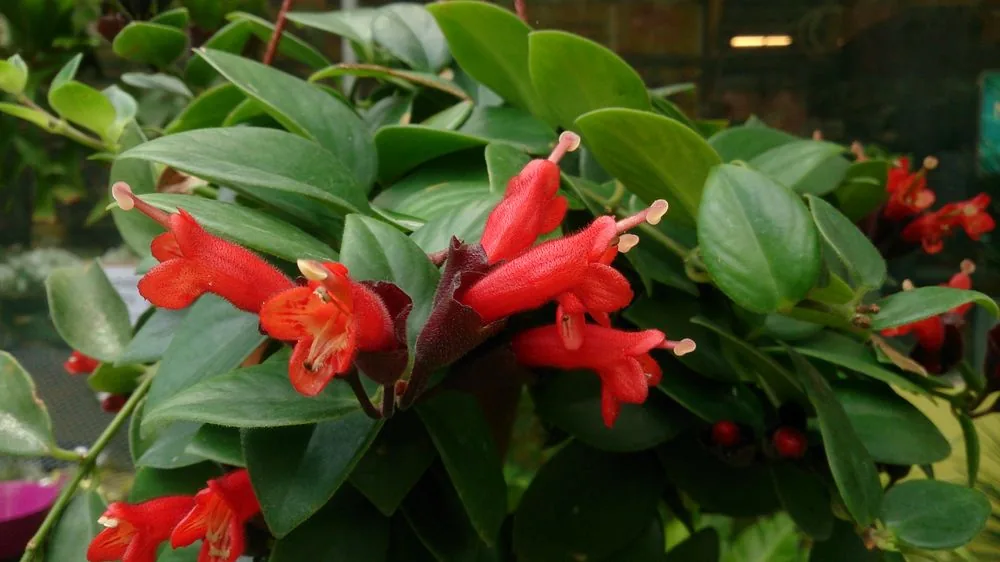
Clusters of bright red tubular lipstick plant flowers among glossy, dark green leaves

Lipstick plant

Aeschynanthus radicans
Care level: Moderate

The lipstick plant is a trailing evergreen from the rainforests of Malaysia and Indonesia, where it grows on tree branches. Its long, arching stems carry pairs of thick, leathery, dark green leaves and end in clusters of flowers. Each bright red, tubular flower pushes out of a dark burgundy cup, like a lipstick rising from its case, which gives the plant its name. It flowers on and off from spring to autumn and is nearly always grown in a hanging basket, where the stems can hang freely.

I have this plant

Information

Varieties and related species
Aeschynanthus 'Mona Lisa'Aeschynanthus 'Twister'Aeschynanthus marmoratus

Light

Bright, filtered light. Avoid direct midday sun, which scorches the leaves; too little light means no flowers.

Water

Water freely in growth when the top of the compost has dried, and sparingly in winter. Never leave it standing in water.

Humidity

Moderate to high humidity. Mist in heated rooms.

Soil

An open, free-draining, peat-free houseplant compost with added bark and perlite.

Temperature

Warm rooms all year, ideally 18-24°C and not below about 15°C. Keep it away from cold draughts.

Size

A trailing plant with stems 30-90cm long.

Growth speed

Medium

Pet safety not confirmed

As a precaution, keep it out of reach of children and pets.

Beginner tip

Flowers come from light and from being left alone at the right moment. The buds form at the tips of the stems, so trim the plant straight after a flush of flowers, never in late winter or spring, and hang it in the brightest spot you have out of direct midday sun.

Care by Season

Spring

Growth resumes. Water more, begin feeding and take cuttings.

Summer

Flowers. Water freely and trim after each flush.

Autumn

Flowering tails off. Reduce feeding and watering.

Winter

Keep a little cooler and drier, in the brightest place available, away from draughts.

Growing & Maintenance

Repotting

Repot in spring every two to three years into a pot one size larger. A hanging pot with drainage holes and a saucer is ideal.

Fertilising

Feed monthly from mid-spring to late summer with a general liquid fertiliser at half strength.

Pruning

Trim weak or over-long shoots after flowering. Do not prune in late winter or spring, when the stem tips are setting buds.

Propagation

By softwood cuttings in spring or semi-ripe cuttings in summer, rooted in warmth and high humidity.

Pests & Diseases

Common problems

No flowers

Most likely cause: Too little light or pruning at the wrong time.
What to do: Move to brighter, filtered light and prune only after flowering.

Leaves drop

Most likely cause: Cold draughts, waterlogging or drought.
What to do: Keep it warm and water evenly.

Buds fall before opening

Most likely cause: The plant was moved, or the compost dried out while in bud.
What to do: Leave it in one place and keep the watering steady.

Long, bare stems

Most likely cause: Age and low light.
What to do: Cut back after flowering and root the tips.

Brown, scorched patches

Most likely cause: Direct midday sun.
What to do: Move it out of strong sun.

Soft, yellow leaves

Most likely cause: Compost kept too wet.
What to do: Let it dry out more between waterings and check the drainage.

Pests & Diseases

Aphids

Signs: Clusters of small insects on the shoot tips and flower buds, with sticky honeydew.
Treatment: Wipe or rinse them off and repeat every few days.

Mealybugs

Signs: White, woolly tufts in the leaf joints and along the stems.
Treatment: Dab them with a cotton bud dipped in methylated spirit and repeat weekly until they are gone. Check the undersides of the leaves and the crevices where the leaf stem meets the main stalk.

Red spider mite

Signs: Leaves turn dull and finely speckled in warm, dry air, sometimes with fine webbing.
Treatment: Rinse the plant under lukewarm water and raise the humidity. Check the undersides of the leaves and the crevices where the leaf stem meets the main stalk.

Grey mould

Signs: Fluffy grey mould on flowers and leaves in cool, damp, still air.
Treatment: Remove affected parts, water less and give more warmth and air.

FAQ

Why is my lipstick plant not flowering?

Almost always too little light. It needs bright, filtered light for most of the day. Other causes are pruning at the wrong time, which removes the stem tips where buds form, a pot that is much too large, and constant warmth with no slightly cooler, drier spell in winter.

How often should I water it?

Water freely in spring and summer whenever the top couple of centimetres of compost have dried, and let the surplus drain away. In winter water sparingly. The thick leaves store some water, so it tolerates drying a little far better than wet, airless compost.

Why are the leaves falling off?

Cold draughts, waterlogged compost or a long drought. Check that the pot drains, keep the plant above 15°C and water more evenly. Bare stems can be cut back after flowering to make them branch.

When and how do I prune it?

After flowering. Shorten the longest stems by up to a third to keep the plant full, and remove weak, bare shoots. Use the cut tips as cuttings.

Does it need high humidity?

It prefers humid air but copes with normal rooms better than many rainforest plants because of its thick leaves. Mist it in heated rooms or hang it in a bright bathroom or kitchen.

How do I propagate it?

Take stem tip cuttings 8-10cm long in spring or summer, strip the lower leaves and root them in moist, open compost in a warm, humid place. Several cuttings in one pot make a full plant sooner.

When should I repot it?

Only every two to three years. It flowers best when slightly pot-bound. Move it into a pot one size larger in spring, using an open, free-draining mix.

You might also like