No results. Is a plant missing? Tell uscontact@wikiplant.net
Japanese Honeysuckle
Lonicera japonica
Care level: Easy
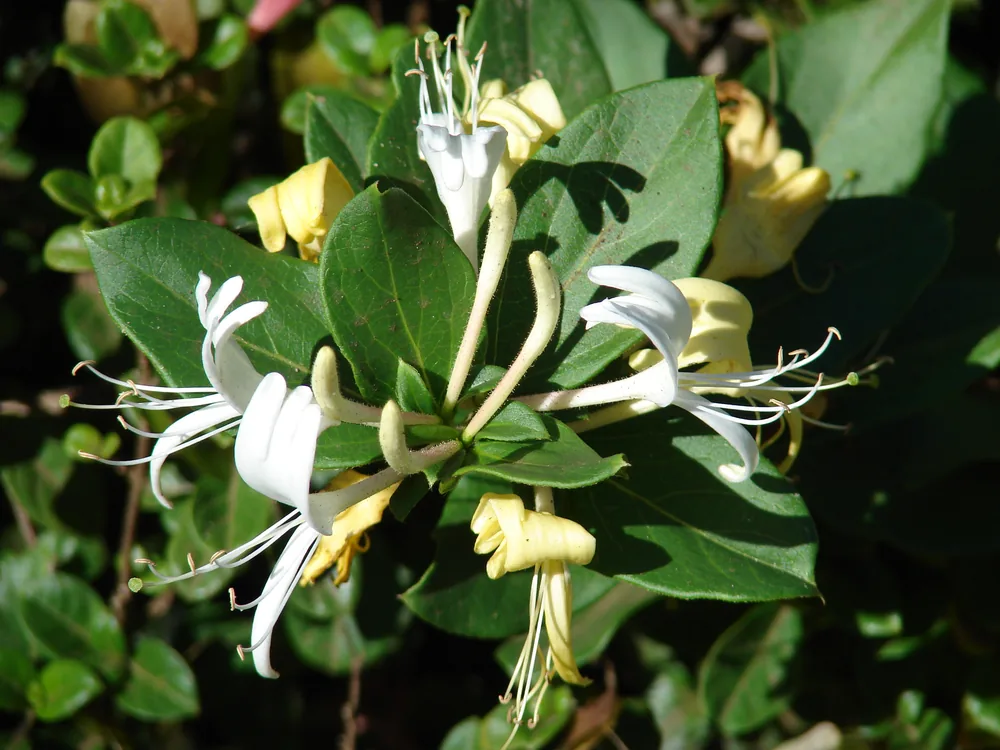
Japanese Honeysuckle is a vigorous twining climber grown for flowers that are powerfully scented in the evening. The tubular blooms open white and age to deep yellow, so an established plant carries both colours at once. It is almost evergreen in a mild winter, flowers over a very long season, and will cover a fence faster than almost anything else, which is both its great merit and the thing to think about before planting it.
Lonicera japonica 'Halliana'Lonicera periclymenumLonicera x heckrottii
Light
Sun or partial shade, with the classic requirement of roots in shade and top growth in sun. Full shade produces leaf and little flower.
Water
Keep the root area moist, especially the first two summers and on any plant against a wall. Drought at the root is the main trigger for the mildew that disfigures honeysuckles in late summer.
Humidity
Not a factor outdoors, though a crowded plant in still air is much more prone to mildew.
Soil
Any reasonable soil that holds some moisture. Mulching the root zone is more useful here than feeding.
Temperature
Hardy to about -15°C. Semi-evergreen in a mild winter.
As a precaution, keep it out of reach of children and pets.
Signature feature
The scent is timed for moths, not for people. It is faint during the day and becomes intense at dusk, carrying several metres on still summer evenings. Plant it where you sit outside after dark rather than where you pass at midday, and the difference is startling.
Care by Season
Spring
Growth restarts quickly. Mulch the base generously. Do not prune now, as the flower buds are already on last year's wood.
Summer
Main flowering. Aphids and mildew both appear in warm dry spells; water at the root rather than reaching for a spray. Prune once the first flush is over.
Autumn
Often still flowering in a mild season, followed by small black berries. Tie in or shorten whippy new growth so winter wind does not tear it off its support.
Winter
Hardy to around -15°C and semi-evergreen in a mild winter, losing its leaves entirely in a cold one. A good season to thin out old congested stems at the base.
Growing & Maintenance
Planting
In sun or partial shade, with the roots in shade and the top in sun, in any reasonable soil that holds some moisture. Mulch the root zone and keep it moist for the first two summers.
Pruning
Straight after the main flush of flowers. It can be cut back hard.
Support
It twines, so give it wires or a trellis and tie in or shorten the whippy new growth in autumn.
Propagation
By layering, or from stem cuttings.
Pests & Diseases
Common problems
White, powdery coating on the leaves
Most likely cause: Powdery mildew, nearly always a sign of dryness at the root.
What to do: Mulch and water at the root in dry spells.
Curled, sticky shoot tips
Most likely cause: Aphids.
What to do: Blast them off with water and leave the predators to finish the job.
Leaves browning and dropping
Most likely cause: Honeysuckle leaf blight.
What to do: Clear and destroy fallen leaves and improve the air movement.
Few flowers
Most likely cause: Full shade.
What to do: Grow it where the top growth gets sun.
A tangled mass with a bare base
Most likely cause: No pruning.
What to do: Cut it back hard straight after flowering.
Pests & Diseases
Aphids
Signs: Dense colonies on the soft shoot tips and flower buds, with distorted growth and sticky honeydew below; extremely common on honeysuckle.
Treatment: Blast off with water and leave predators to finish the job. A well-watered, well-mulched plant is much less affected than a dry one.
Powdery mildew
Signs: White dusty coating over the leaves from midsummer, which then yellow and drop, sometimes leaving the plant half bare by September.
Treatment: Nearly always a symptom of dryness at the root. Mulch and water deeply, thin the growth for airflow, and accept some late-season mildew as normal.
Honeysuckle leaf blight
Signs: Brown or black blotches spreading across the leaves in a wet summer, with early leaf fall.
Treatment: Clear and destroy fallen leaves, improve air movement by thinning, and avoid overhead watering.
FAQ
Is Japanese Honeysuckle invasive?
In parts of North America and Australia, seriously so, and it is regulated in several of them. In western European gardens it is not classed as invasive but it is genuinely vigorous: it twines tightly and can strangle the stems of a young shrub or small tree it climbs into. Give it a fence, a pergola or a wall with wires, keep it off living woody plants, and cut it back hard whenever it exceeds its space. Check your own local guidance before planting if you are outside Europe.
When and how hard should I prune it?
Straight after the main flush of flowers, and without much hesitation. It flowers on growth made the previous year, so pruning in spring removes the buds. Cut the whole plant back by up to a third after flowering, and take out a proportion of the oldest stems at the base to stop it turning into a bare tangle with all the growth on top, which is the usual fate of an unpruned honeysuckle.
How hardy is Japanese Honeysuckle?
It is hardy to around -15°C. It stays semi-evergreen in a mild winter and loses its leaves in a cold one.
How fast does Japanese Honeysuckle grow?
Fast. It climbs to between 4.9 and 9m, so it needs a strong support and yearly pruning.
When does Japanese Honeysuckle flower?
From late spring through summer, and often still in autumn in a mild season. The white flowers fade to yellow and smell strongest at dusk.
Where should I plant Japanese Honeysuckle?
With its roots in shade and its top growth in sun. Any reasonable soil will do, as long as the root area stays moist.