No results. Is a plant missing? Tell uscontact@wikiplant.net
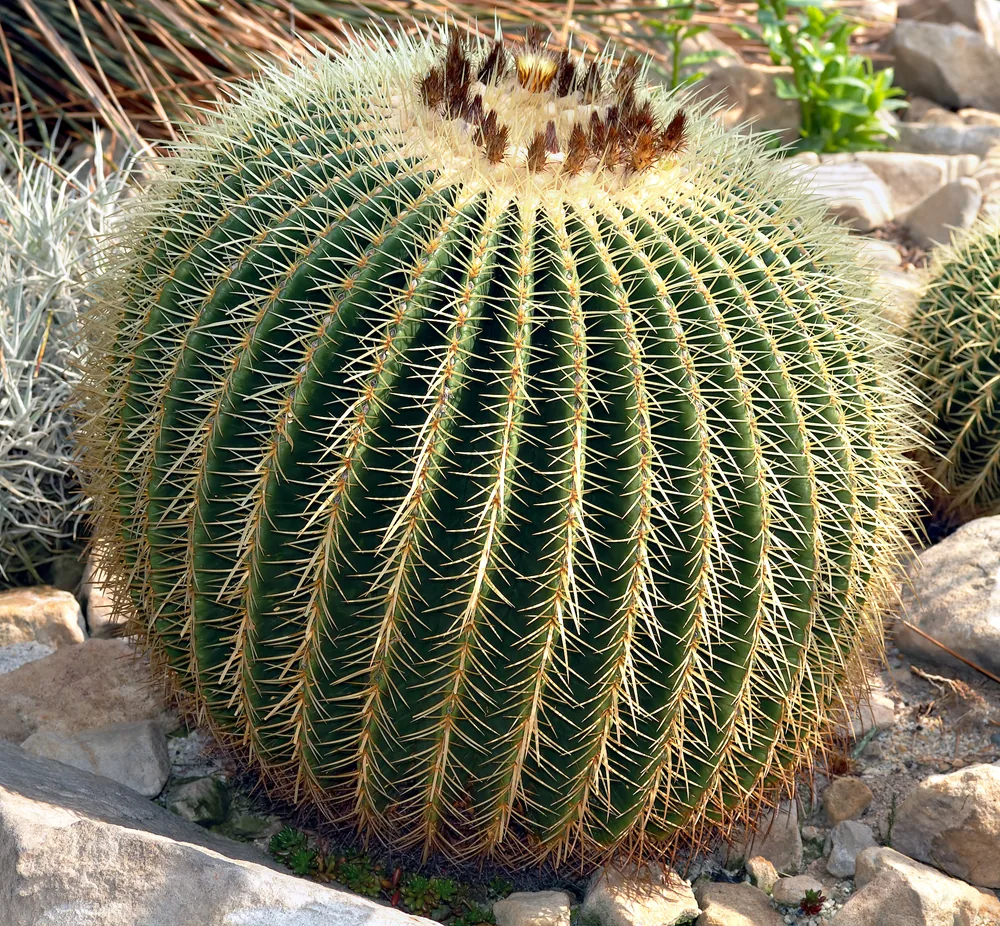
Golden Barrel Cactus
Echinocactus grusonii
Care level: Easy
Sometimes nicknamed 'mother-in-law's cushion,' the golden barrel cactus grows in a near-perfect sphere ringed with stiff golden spines, a shape and color combination that made it enormously popular in gardens even as it became critically endangered in its native Mexico due to habitat loss from a dam project. A mature specimen can take decades to reach its full size, growing only a few centimeters wider per year, so a large golden barrel in a garden or collection often represents an investment of many years.
Echinocactus grusonii var. albispinusEchinocactus platyacanthusEchinocactus horizonthalonius
Light
Full direct sun for most of the day; insufficient light causes weak, etiolated growth.
Water
Let soil dry out completely between waterings, roughly every 2-4 weeks, less in winter.
Humidity
Prefers very low humidity and dry air, reflecting its desert habitat.
Soil
Very fast-draining cactus or succulent mix with coarse sand or grit.
Best position
south-east / south / south-west-facing windowanywhere up to about 1 m from the window
east / west-facing windowright by the window
See every window directionHide window directions
Best position
right by the window
about 1 m
about 2 m
about 4 m
4 m or more
north
too dark○
too dark○
too dark○
too dark○
too dark○
north-east
too dark○
too dark○
too dark○
too dark○
too dark○
east
works well✓
too dark○
too dark○
too dark○
too dark○
south-east
works well✓
works well✓
too dark○
too dark○
too dark○
south
works well✓
works well✓
too dark○
too dark○
too dark○
south-west
works well✓
works well✓
too dark○
too dark○
too dark○
west
works well✓
too dark○
too dark○
too dark○
too dark○
north-west
too dark○
too dark○
too dark○
too dark○
too dark○
✓works well~just about○too dark☼too much direct sun
A rough guide based on window direction and typical daylight through the year. Window size, curtains and whatever stands outside matter just as much.
?Pet safety not confirmed
As a precaution, keep it out of reach of children and pets.
Did you know?
Echinocactus grusonii is classified as endangered in the wild, with its only natural habitat largely submerged by a reservoir in Mexico decades ago; nearly all golden barrel cacti sold today are cultivated, not wild-collected.
Care by Season
Spring
Resume watering gradually as soil dries and begin light feeding with cactus fertilizer.
Summer
Water once soil is fully dry and provide maximum sun exposure for healthy round growth.
Autumn
Taper off watering and stop feeding as the plant prepares for winter dormancy.
Winter
Water very rarely, if at all, and keep in a cool, bright spot away from frost.
Growing & Maintenance
Soil and pot
A very fast-draining cactus mix with coarse sand or grit, in a pot with drainage holes.
Fertilising
A light feed with cactus fertiliser in spring and summer. Stop in autumn.
Propagation
From seed.
Pests & Diseases
Common problems
Leaning or lopsided growth
Most likely cause: The plant grows toward its strongest light.
What to do: Turn the pot a little every few weeks.
Pale, elongated growth
Most likely cause: Too little direct sun.
What to do: Give it full, direct sun for most of the day.
Soft, discoloured base
Most likely cause: Root rot from overwatering.
What to do: Stop watering, let the plant and compost dry completely and repot in fresh, gritty mix.
Shrivelled, sunken ribs
Most likely cause: A very long dry spell in the growing season.
What to do: Water thoroughly once the compost is dry, then let it dry out fully again.
Pale, scorched patches
Most likely cause: A sudden move from shade into full sun.
What to do: Increase the sun exposure gradually.
Pests & Diseases
Mealybugs
Signs: White cottony spots nestled between the ribs near the spines.
Treatment: Remove with an alcohol-soaked cotton swab, taking care around the spines. Check the undersides of the leaves and the crevices where the leaf stem meets the main stalk.
Scale insects
Signs: Small brown bumps along the ribs that are hard to dislodge.
Treatment: Scrape off gently and treat with insecticidal soap.
Root rot
Signs: Soft, discolored base and a foul smell from overly wet, poorly draining soil.
Treatment: Stop watering, let the plant and soil dry completely, and repot into fresh, gritty mix if rot persists.
FAQ
Why is my golden barrel cactus leaning or growing lopsided?
Barrel cacti grow toward their strongest light source, so uneven light causes lopsided growth; rotate the pot a quarter turn every few weeks if grown indoors or near a single window to encourage even, symmetrical growth.
How often does a golden barrel cactus actually need water?
Much less than most houseplants, water only when the soil is fully dry, roughly every 2-4 weeks in the growing season and far less in winter, since overwatering is the most common cause of death in this species.
How much light does a golden barrel cactus need?
It needs full, direct sun for most of the day. In weak light it grows pale and loses its round shape.
How should I overwinter a golden barrel cactus?
In a cool, bright spot away from frost. Water very rarely, if at all, until spring.
How do I propagate a golden barrel cactus?
From seed. It is a solitary cactus that rarely forms offsets, so seed is the usual way to raise new plants.
How do I handle a golden barrel cactus safely?
With thick gloves, or by wrapping it in folded newspaper when you repot. The spines are stiff and sharp.