No results. Is a plant missing? Tell uscontact@wikiplant.net
Gooseberry
Ribes uva-crispa
Care level: Easy
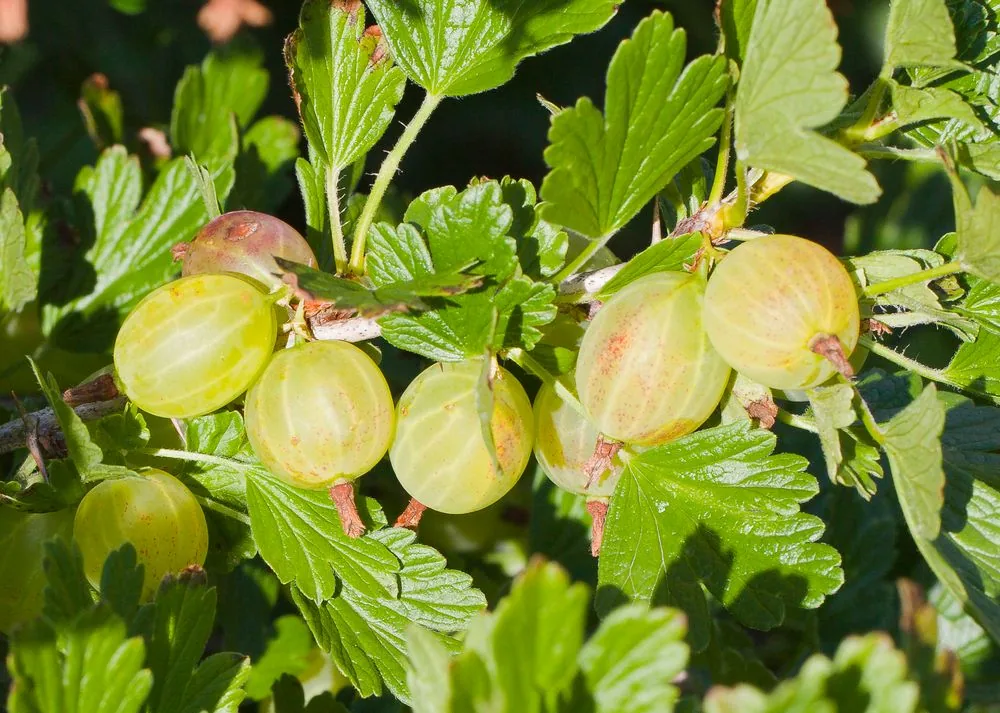
The gooseberry is a bushy, thorny fruit shrub with deeply lobed leaves, small greenish flowers in spring and oval berries that ripen in midsummer in green, yellow, pink or red. Picked early, the fruit is sharp and made for cooking; left to ripen, many varieties turn sweet enough to eat raw. It is fully hardy, tolerant of partial shade and of cooler, wetter summers than most fruit, and can be grown as an open bush or trained flat against a fence.
As a precaution, keep it out of reach of children and pets.
Beginner tip
Pick the crop in two stages. In late spring take about half the berries while they are still hard and green, and use them for cooking. The fruit left on the bush then has room to swell and ripens larger and sweeter a few weeks later.
Care by Season
Spring
Flowers open early; protect them from hard frost. Mulch, and start checking for sawfly caterpillars.
Summer
Thin the crop in late spring, pick the rest in midsummer and shorten the new side shoots. Net against birds.
Autumn
The leaves fall. Planting time begins.
Winter
Prune while the bush is dormant and take hardwood cuttings.
Growing & Maintenance
Planting
Plant while dormant in moist, well-drained soil improved with organic matter, in sun or partial shade. Allow about 1.5m between bushes, or train plants as cordons against a support.
Pruning
In winter, open the centre, shorten the main branches by a quarter and cut side shoots to one to three buds. In early summer, shorten new side shoots to five leaves.
Propagation
By hardwood cuttings in winter.
Pests & Diseases
Common problems
A bush stripped of leaves
Most likely cause: Gooseberry sawfly caterpillars.
What to do: Pick them off as soon as they appear; the bush usually recovers.
Grey-brown felt on the fruit
Most likely cause: Gooseberry mildew.
What to do: Rub it off before cooking, and prune for better air movement.
Small fruit
Most likely cause: Too heavy a crop, or dry soil.
What to do: Thin the fruit in late spring and water while it swells.
Split berries
Most likely cause: Heavy watering or rain after a dry spell.
What to do: Water regularly so that the soil stays evenly moist.
Buds missing in spring
Most likely cause: Birds in winter.
What to do: Net the bush or prune late.
Scratched arms at picking time
Most likely cause: Thorns in a crowded bush.
What to do: Keep the centre open, or grow the plant as a cordon.
Pests & Diseases
Gooseberry sawfly
Signs: Leaves eaten down to the veins, starting low in the centre of the bush, by pale green caterpillars with black spots.
Treatment: Check the undersides of the leaves from mid-spring and pick off the caterpillars by hand. There can be several generations in a season.
Gooseberry mildew
Signs: A white, powdery coating on young leaves, shoot tips and fruit that later turns brown and felt-like.
Treatment: Cut out affected tips, prune for an open bush and grow a resistant variety.
Birds
Signs: Buds pecked out in winter and ripe fruit taken in summer.
Treatment: Net the bush when the fruit starts to ripen, and delay winter pruning until the buds begin to swell if birds strip them.
Leaf spot
Signs: Small dark spots on the leaves, which yellow and fall early.
Treatment: Rake up fallen leaves in autumn and feed and water the bush so that it regrows strongly.
FAQ
When and how do I prune a gooseberry?
Twice a year. In winter, cut out dead and crossing branches to keep the centre of the bush open, shorten the main branches by about a quarter and cut the side shoots back to one to three buds. In early summer, shorten the new side shoots to about five leaves.
What has stripped the leaves from my gooseberry bush?
Gooseberry sawfly. Its pale green, black-spotted caterpillars start low in the centre of the bush and can strip it bare in days. Check the undersides of the leaves from mid-spring and pick the caterpillars off as soon as you see them.
Why are the shoots and fruit covered in white-grey felt?
That is gooseberry mildew. It is worst on crowded bushes in still air. Cut out the affected shoot tips, keep the centre of the bush open when pruning and choose a resistant variety when replanting. Affected berries can still be eaten once the coating is rubbed off.
Can gooseberries grow in shade?
They tolerate partial shade better than most fruit and still give a useful crop, though fruiting is best in full sun.
Do I need more than one bush?
No. Gooseberries are self-fertile, so one bush will crop by itself.
Can I grow a gooseberry in a small garden?
Yes. Train it as a single upright stem, a cordon, against a fence or wall. A cordon takes very little room and makes picking among the thorns much easier.