No results. Is a plant missing? Tell uscontact@wikiplant.net
Houseleek
Sempervivum tectorum
Care level: Very easy
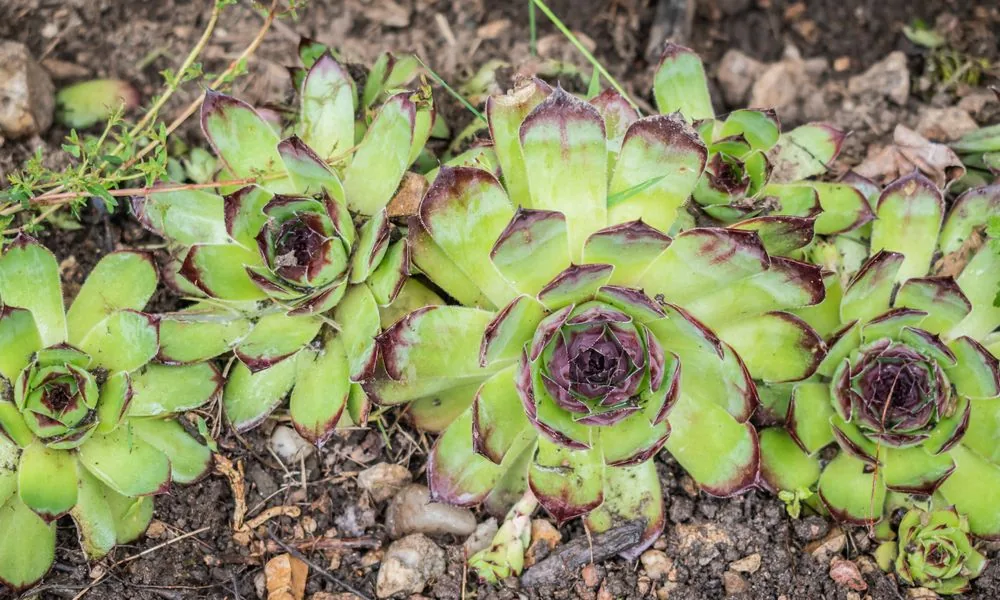
The houseleek is a mat-forming alpine succulent from the mountains of southern Europe, with tight, fleshy rosettes up to 10cm across, blue-green flushed with red-purple at the tips. Each rosette, the hen, surrounds itself with small offsets, the chicks, on short runners, so a single plant becomes a cushion. It is fully hardy and all but indestructible outdoors: it grows in a handful of gritty soil in a wall crevice, a trough, a shallow bowl or on a roof, which is where it was planted for centuries and where its name comes from.
As a precaution, keep it out of reach of children and pets.
Common mistake
This is an outdoor plant. Sold alongside houseplant succulents, it fails on a windowsill: indoors it stretches, loses its colour and rots. It needs full sun, rain, fresh air and winter cold, and the only things that kill it are shade and wet feet.
Care by Season
Spring
Growth resumes and offsets form. Plant, divide and tidy away dead leaves.
Summer
Mature rosettes flower. Remove them afterwards and fill the gaps with offsets.
Autumn
Colours deepen as nights cool. Clear fallen leaves from the cushions.
Winter
Fully hardy. Keep them outdoors and protect them only from standing wet.
Growing & Maintenance
Planting
Plant in spring or early autumn in full sun, in gritty soil, a wall crevice, a trough or a shallow pot with drainage holes. Top the surface with grit to keep the necks dry.
Fertilising
None needed. Feeding makes the rosettes soft, green and prone to rot.
Pruning
No pruning is needed. Twist out rosettes that have flowered and died.
Propagation
By detaching rooted offsets in spring, or by seed sown in spring.
Pests & Diseases
Common problems
Rosettes open flat and turn green
Most likely cause: Too little sun.
What to do: Move them into full sun.
Tall, stretched growth
Most likely cause: Shade, or life indoors.
What to do: Grow them outdoors in the open.
Brown, mushy centre
Most likely cause: Rot from wet soil.
What to do: Add grit, raise the pot on feet and water less.
A rosette dies after flowering
Most likely cause: The normal end of that rosette.
What to do: Remove it; the offsets fill the gap.
Lower leaves dry and papery
Most likely cause: Normal ageing of the outer leaves.
What to do: Pull them away if they bother you.
Rosettes loose with no roots
Most likely cause: Vine weevil grubs.
What to do: Clear out the grubs and replant in fresh compost.
Pests & Diseases
Vine weevil
Signs: Rosettes that come loose in the hand or collapse; cream, C-shaped grubs eating the roots, mostly in pots.
Treatment: Tip out the pot, remove the grubs, and replant healthy rosettes in fresh, gritty compost.
Houseleek rust
Signs: Rosettes that grow abnormally upright with long, narrow, pale leaves, and orange-brown pustules on them.
Treatment: Remove and destroy affected rosettes promptly; healthy neighbours usually stay clean.
Rot
Signs: The centre of a rosette turns brown and mushy in wet soil or under a layer of fallen leaves.
Treatment: Remove rotten rosettes, improve the drainage and clear debris from the cushions.
Birds
Signs: Rosettes pulled out and scattered, mostly in newly planted pots.
Treatment: Push them back in; cover new plantings with netting for a few weeks until they root.
FAQ
Can I grow houseleeks indoors?
Not for long. They need far more light than a room gives and a cold winter rest. Indoors the rosettes open flat, stretch upwards and turn pale green. Keep them outside all year, in the ground or in a pot.
Why did the rosette die after flowering?
That is its life cycle. A rosette grows for a few years, sends up one thick stem of starry pink-purple flowers and then dies. The offsets around it take its place, so the clump lives on. Twist out the dead rosette.
How often should I water them?
In the ground, never, once established. In pots, water only in long dry spells in summer and let the compost dry out completely in between. Too much water is the main cause of losses.
Do they survive frost and snow?
Yes, completely. They are alpine plants. What they dislike in winter is standing wet, so the soil or compost must drain freely; raise pots on feet.
How do I plant them in a wall or on a roof?
Push a rosette with a little of its root and a pinch of gritty soil into a crack or onto a thin layer of substrate. Water it once. It roots within weeks and looks after itself.
How do I propagate them?
Pull off an offset with its runner in spring or summer and press it onto gritty soil. Nothing more is needed.