No results. Is a plant missing? Tell uscontact@wikiplant.net
Lithops
Lithops spp.
Care level: Moderate
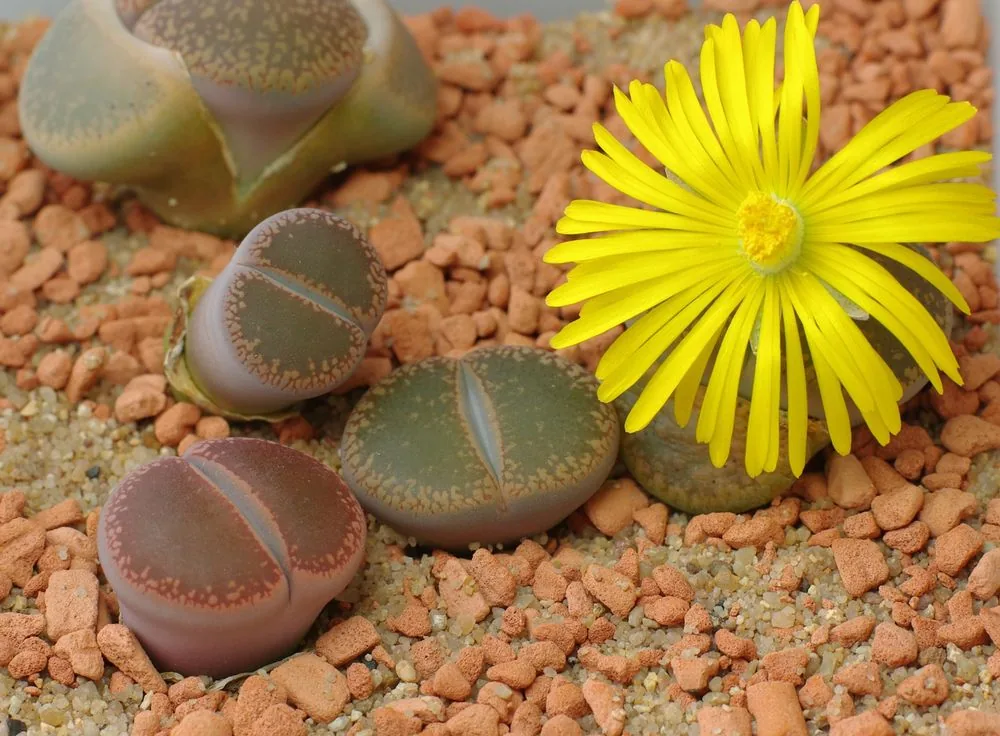
Lithops, the living stones, are tiny succulents from the deserts of southern Africa that have evolved to look like the pebbles around them. Each plant is a single pair of thick, fused leaves with a slit across the top, patterned in greys, browns, greens and rust. In autumn a daisy-like flower, yellow or white and often wider than the plant itself, pushes out of the slit. Most of the plant sits below the surface. They are easy to keep alive on a sunny windowsill for decades, as long as you follow their unusual watering calendar.
Four to five hours of direct sun, ideally morning sun, with a little shade from the fiercest afternoon sun behind glass.
Water
Water by the calendar, not by appearance: lightly in late spring, none in midsummer, every two weeks from late summer through autumn, and none at all in winter and early spring.
Humidity
Dry air and good ventilation. Never mist.
Soil
A very gritty, fast-draining mix: cactus compost with at least half grit, pumice or coarse sand, in a deep pot with drainage holes.
Temperature
Keep it above about 5°C and protect it from frost. Ordinary room temperatures suit it.
Size
A few centimetres tall and wide; clumps spread very slowly.
Growth speed
Slow
?Pet safety not confirmed
As a precaution, keep it out of reach of children and pets.
Common mistake
Do not water in winter, however shrivelled the plant looks. A new pair of leaves is forming inside the old pair and living on its water. Watering at this stage makes the old leaves swell again and the plant rots or stacks up in layers.
Care by Season
Spring
No water until the old leaves have dried to husks, then begin light watering in late spring.
Summer
The plants rest in midsummer heat; keep them dry. Resume watering at the end of summer.
Autumn
Growth and flowering. Water about every two weeks and stop as the flowers fade.
Winter
Completely dry. New leaves form inside the old pair. Keep the plants bright and frost free.
Growing & Maintenance
Repotting
Repot only every few years, in late spring, into a pot at least 10cm deep to take the long tap root. Set the bodies so that only the tops stand above the surface and cover the surface with grit.
Fertilising
Very little. A single weak dose of cactus fertiliser in the autumn growing period is enough, and many growers give none.
Propagation
By seed sown on the surface of gritty compost in warmth, or by dividing a clump carefully at repotting time so that each head keeps part of the root.
Pests & Diseases
Common problems
Soft, translucent, collapsing body
Most likely cause: Rot from watering in the wrong season or from compost that stays wet.
What to do: Remove it; water the others only in the growing periods.
Tall, stretched, pale bodies
Most likely cause: Too little light.
What to do: Move to a sunnier position gradually.
Wrinkled sides in winter
Most likely cause: The old leaves handing their water to the new pair.
What to do: Normal; do not water.
Several layers of leaves stacked up
Most likely cause: Watering while the new leaves were forming.
What to do: Keep it dry until the old leaves have withered.
A burst or split side
Most likely cause: Too much water at once.
What to do: Water less and less often; the scar remains but the plant lives.
Brown, corky patches on top
Most likely cause: Sunburn after a sudden move into strong sun.
What to do: Accustom plants to full sun over a week or two.
Pests & Diseases
Mealybugs
Signs: White, woolly tufts in the slit, between the bodies or on the roots; plants that stop growing for no visible reason.
Treatment: Dab them off with a cotton bud dipped in alcohol. For root mealybugs, wash the roots and repot in fresh, dry mix. Check the undersides of the leaves and the crevices where the leaf stem meets the main stalk.
Red spider mite
Signs: Fine pale or rusty scarring on the surface of the bodies in hot, dry, still air.
Treatment: Increase ventilation and wipe the bodies with a damp cotton bud. Check the undersides of the leaves and the crevices where the leaf stem meets the main stalk.
Rot
Signs: A body that turns soft, translucent and collapses, often overnight, after watering.
Treatment: Remove the rotten plant at once so that it does not spread to its neighbours, and keep the rest dry.
FAQ
When should I water lithops?
Lightly from late spring to early summer, once the old leaves have dried to papery husks. Stop in the heat of midsummer, when the plants rest. Water again from late summer through autumn, about every two weeks, while they grow and flower. Give no water at all in winter and early spring.
Why is my lithops splitting open?
That is how it grows. Once a year a new pair of leaves emerges through the slit and the old pair withers around it. Leave the old leaves in place until they are completely dry.
Why has it turned soft and mushy?
Rot from too much water or water at the wrong time. A rotting lithops can rarely be saved. Water only in the growing periods and let the compost dry out fully in between.
Why is it growing tall and leaning?
Too little light. In shade the bodies stretch upwards, lose their markings and become weak. Give them four to five hours of direct sun, ideally in the morning.
When does it flower?
In autumn, on plants at least three years old that have had a sunny summer. The flowers open in the afternoon and close at night.
Can I plant several together?
Yes, they look best in groups, but put only lithops together. Other succulents need water when lithops must stay dry.