No results. Is a plant missing? Tell uscontact@wikiplant.net
Madagascar palm
Pachypodium lamerei
Care level: Easy
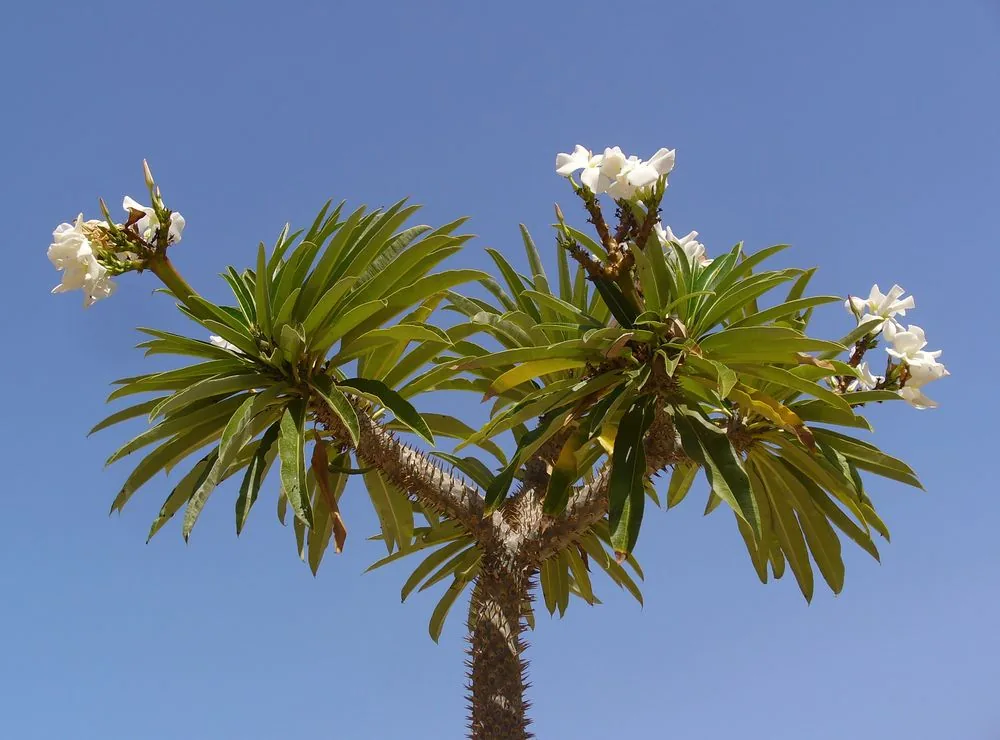
The Madagascar palm is not a palm but a succulent tree from the dry south of Madagascar. Its thick, silver-grey trunk stores water and is covered from top to bottom in clusters of long, needle-sharp spines; at the top sits a tuft of long, narrow, glossy leaves, which is what gives it its palm-like outline. Old plants branch and bear scented, white, yellow-throated flowers in summer, though rarely indoors. It is a slow, tough and striking houseplant that asks for the sunniest place you have, warmth, and a dry rest in winter.
Full sun all year. Turn the pot now and then so that the trunk grows straight.
Water
Water moderately from late spring to early autumn, letting the compost dry out between waterings. Keep it dry at other times.
Humidity
Dry air suits it. Never mist.
Soil
A standard cactus compost with added grit, in a heavy pot with drainage holes.
Temperature
Keep it warm all year, ideally above 15°C. It does not tolerate frost or cold, wet compost.
Size
2.5-4m in time under glass; usually 1-2m in a pot indoors.
Growth speed
Slow
?Pet safety not confirmed
As a precaution, keep it out of reach of children and pets.
Did you know?
It drops its leaves in winter, and that is normal. As the days shorten the leaves yellow and fall, sometimes all of them, and the plant rests as a bare, spiny column. Keep it dry and warm until new leaves sprout from the top in spring; watering a leafless plant is the surest way to rot it.
Care by Season
Spring
New leaves sprout from the top. Resume watering gradually and repot if needed.
Summer
Water when dry, feed every four to five weeks and stand it outdoors in full sun if you can.
Autumn
Leaves yellow and begin to fall. Reduce watering and bring the plant in before nights turn cold.
Winter
Leafless or nearly so. Keep it warm, bright and dry.
Growing & Maintenance
Repotting
Repot every two or three years in late spring into a heavy clay pot only slightly larger. Wrap the trunk in folded newspaper to handle it.
Fertilising
Feed every four to five weeks from late spring to early autumn with a low-nitrogen liquid fertiliser. Do not feed at other times.
Pruning
No pruning is needed. If the top is damaged or cut, the plant branches below the wound.
Propagation
By seed sown at 19-24°C, or by stem-tip cuttings in late spring, dried until the cut has callused.
Pests & Diseases
Common problems
All the leaves fall in winter
Most likely cause: Natural dormancy.
What to do: Keep it dry and warm; new leaves follow in spring.
Leaves fall in summer
Most likely cause: Cold, a move to low light, or wet roots.
What to do: Give it full sun and warmth and let the compost dry out.
Soft, dark patch on the trunk
Most likely cause: Rot from overwatering.
What to do: Cut out the rot and keep the plant dry.
The trunk wrinkles or shrivels
Most likely cause: Prolonged drought in the growing season.
What to do: Water thoroughly; it firms up again.
A thin, leaning top
Most likely cause: Too little light.
What to do: Move it to the sunniest position and turn the pot regularly.
Black leaf tips
Most likely cause: Cold draughts or water left on the leaves in cool conditions.
What to do: Keep it above 15°C and water the compost, not the crown.
Pests & Diseases
Aphids
Signs: Clusters of small insects on flower buds and young leaves.
Treatment: Rinse them off or wipe them away.
Red spider mite
Signs: Fine pale speckling on the leaves and thin webbing in hot, dry rooms; leaves drop early.
Treatment: Rinse the leaves in the shower and repeat weekly. Check the undersides of the leaves and the crevices where the leaf stem meets the main stalk.
Mealybugs
Signs: White, woolly tufts at the base of the leaves and among the spines.
Treatment: Dab them off with a cotton bud dipped in alcohol and repeat weekly. Check the undersides of the leaves and the crevices where the leaf stem meets the main stalk.
Rot
Signs: The base or tip of the trunk turns soft and dark in wet compost.
Treatment: Cut back to firm tissue, keep the plant dry and warm, and re-root a healthy top if the base is lost.
FAQ
Why is my Madagascar palm losing its leaves?
In autumn and winter it is a natural rest: reduce watering to almost nothing and wait for spring. Leaf drop in summer points to a shock, usually cold, a sudden move to a darker place, or waterlogged roots.
How often should I water it?
From late spring to early autumn, water moderately whenever the compost has dried out. Keep it dry for the rest of the year, with only an occasional small drink if the trunk starts to shrivel.
How much light does it need?
Full sun. A south-facing window or a conservatory is ideal, and it can stand outside in summer. In poor light the top grows thin and the plant leans towards the window.
Is it dangerous?
The spines are long and very sharp. Position it away from walkways, children and pets, and wrap the trunk in thick, folded newspaper or use heavy gloves when you move or repot it.
Will it flower indoors?
Rarely. Only large, mature plants of 1.5m or more flower, and they need a great deal of sun. Grow it for its form.
Why is the trunk soft at the base?
Rot from wet compost, usually in winter. If the soft area is small, cut it out to clean tissue, dust the wound dry and keep the plant dry and warm. A plant that is soft all round the base cannot be saved, but a healthy top can be cut off, dried for a couple of weeks and re-rooted.