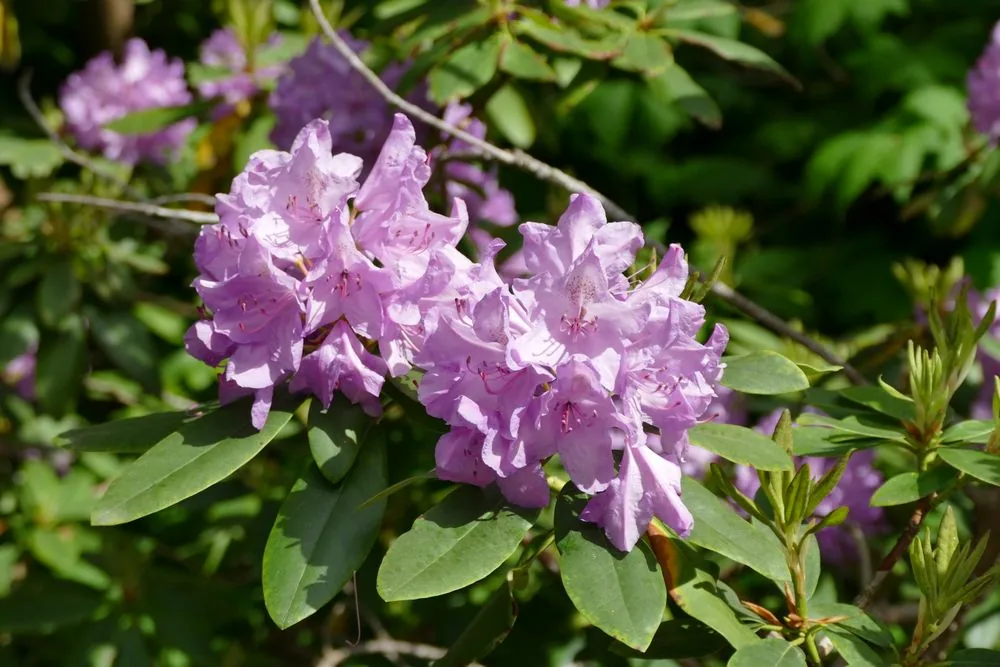
Rounded trusses of lilac-purple rhododendron flowers above dark green, leathery leaves

Rhododendron

Rhododendron spp.
Care level: Moderate

Rhododendrons are woodland shrubs of the heather family, grown for the rounded trusses of funnel-shaped flowers that cover them in spring, in every colour except true blue. The best known are the large evergreen hybrids with leathery, dark green leaves, but the group runs from ground-hugging alpine species to small trees, and it includes the azaleas, which are simply rhododendrons with smaller leaves. They are slow, long-lived and need almost no pruning. What they all demand is acid soil: on lime they turn yellow and fail.

I have this plant

Information

Varieties and related species
Rhododendron yakushimanum hybridsRhododendron 'Cunningham's White'Rhododendron ponticum

Light

Dappled or partial shade, sheltered from cold, drying winds. Small-leaved and dwarf kinds take more sun.

Water

Keep the soil moist, especially in summer when next year's flower buds form. Use rainwater where tap water is hard.

Humidity

Not a factor for this outdoor shrub.

Soil

Acid, humus-rich, moist but well-drained soil. In pots, peat-free ericaceous compost.

Temperature

Most garden rhododendrons are hardy evergreens, but hardiness varies between species and hybrids. Check the plant label for your area.

Size

Dwarf kinds under 1m; most garden hybrids 1.5-3m; some species grow into small trees.

Growth speed

Slow

Toxic to pets

Toxic to cats and dogs if eaten.

Can cause vomiting and diarrhoea, and more rarely affects heart rhythm.

If your pet has eaten some, contact your vet.

Source: NC State Extension, Pet Poison Helpline

Common mistake

Check the soil before you buy. Rhododendrons need acid soil, with a pH between about 4.5 and 6, and no amount of feeding makes up for ground that is alkaline. If hydrangeas flower blue and heathers thrive nearby, the soil suits them. If it is chalky, grow a compact variety in a large pot of ericaceous compost instead.

Care by Season

Spring

Flowers. Deadhead, feed with an ericaceous fertiliser and renew the mulch.

Summer

New growth and next year's buds form. Water in dry spells.

Autumn

Plant new rhododendrons while the soil is warm. Keep watering if the autumn is dry.

Winter

Leaves roll in frost. Protect container plants from freezing through and from winter wind.

Growing & Maintenance

Planting

Plant in autumn or spring in a wide, shallow hole, with the top of the root ball level with the soil surface. Mix composted bark or leaf mould into the surrounding soil and mulch generously.

Fertilising

Apply a fertiliser for acid-loving plants in spring. Mulch every year with composted bark, leaf mould or pine needles; do not use mushroom compost, which contains lime.

Pruning

Little or none. Remove dead wood and faded trusses. Renovate overgrown hybrids by cutting back hard in late winter.

Propagation

By layering a low branch, which roots within a couple of years, or by semi-ripe cuttings in late summer. Named hybrids are often grafted.

Pests & Diseases

Common problems

Yellow leaves with green veins

Most likely cause: Alkaline soil or hard water.
What to do: Use ericaceous feed and mulch, water with rainwater or move the plant to a pot.

No flowers

Most likely cause: Deep shade, drought the previous summer or buds lost to frost.
What to do: Give more light and water in summer.

Brown buds with black bristles

Most likely cause: Bud blast.
What to do: Remove the affected buds.

Leaves rolled and hanging

Most likely cause: Frost, or drought if it persists in mild weather.
What to do: Water thoroughly if the soil is dry.

Brown leaf edges

Most likely cause: Drying wind, drought or fertiliser scorch.
What to do: Give shelter, water and feed lightly.

Plant wilts in wet soil

Most likely cause: Root rot from waterlogging.
What to do: Improve the drainage or replant higher.

Pests & Diseases

Vine weevil

Signs: Notches bitten from the leaf edges by the adults; in pots, the white grubs eat the roots and the plant wilts.
Treatment: Check pots for grubs and apply a nematode drench in late summer.

Bud blast

Signs: Flower buds turn brown or silvery and are covered in small black bristles; they stay on the plant without opening.
Treatment: Pick off and bin affected buds.

Powdery mildew

Signs: Pale yellow patches on the upper leaf surface with a faint grey-brown felt beneath; leaves may drop.
Treatment: Rake up fallen leaves, water in dry spells and improve the air flow around the plant.

Phytophthora root rot

Signs: Leaves droop and turn dull, then the plant dies back, in heavy soil that lies wet.
Treatment: Improve the drainage or replant on a raised mound. Affected plants rarely recover.

Scale insects

Signs: Brown scales and white, waxy egg masses under the leaves, with black sooty mould on the leaves below.
Treatment: Wipe them off and wash the sooty mould from the leaves.

FAQ

Why are the leaves yellow between green veins?

Lime-induced chlorosis: the soil or the water is too alkaline for the roots to take up iron. Mulch with composted bark, pine needles or leaf mould, water with rainwater and apply an ericaceous feed. On strongly alkaline soil, move the plant into a container.

Why did the buds turn brown and never open?

Bud blast, if the dead buds are covered in tiny black bristles and stay on the plant for a year or more; it is a fungus carried by leafhoppers. Pick off and bin affected buds. Plain brown buds that drop are usually caused by frost or by drought the previous summer.

Should I deadhead it?

Yes, on plants small enough to reach. Snap off each faded truss between finger and thumb just above the cluster of new buds beneath it, taking care not to break them. This puts the plant's energy into growth and next year's flowers instead of seed.

When and how do I prune a rhododendron?

It rarely needs pruning. Remove dead or damaged wood after flowering. Many old, leggy hybrids can be cut back hard in late winter and will reshoot from bare wood, though they miss a year or two of flowering; smooth-barked species respond less well.

Why are the leaves curled and drooping in winter?

It is a normal reaction to cold. Evergreen rhododendrons roll and hang their leaves in frost to limit water loss and unroll them when it thaws. If they stay rolled in mild weather, the plant is dry at the root.

Can I grow one in a pot?

Yes. Choose a compact kind, such as a yakushimanum hybrid, and a pot at least 40cm wide with peat-free ericaceous compost. Water with rainwater, never let it dry out and repot or refresh the top layer every two years.

How deep should I plant it?

Shallow. The fine roots sit in the top few centimetres of soil and suffocate if buried. Set the top of the root ball level with the surface, or slightly above it on heavy soil, and cover it with a mulch instead of soil.

You might also like