No results. Is a plant missing? Tell uscontact@wikiplant.net
Satin Pothos
Scindapsus pictus
Care level: Easy
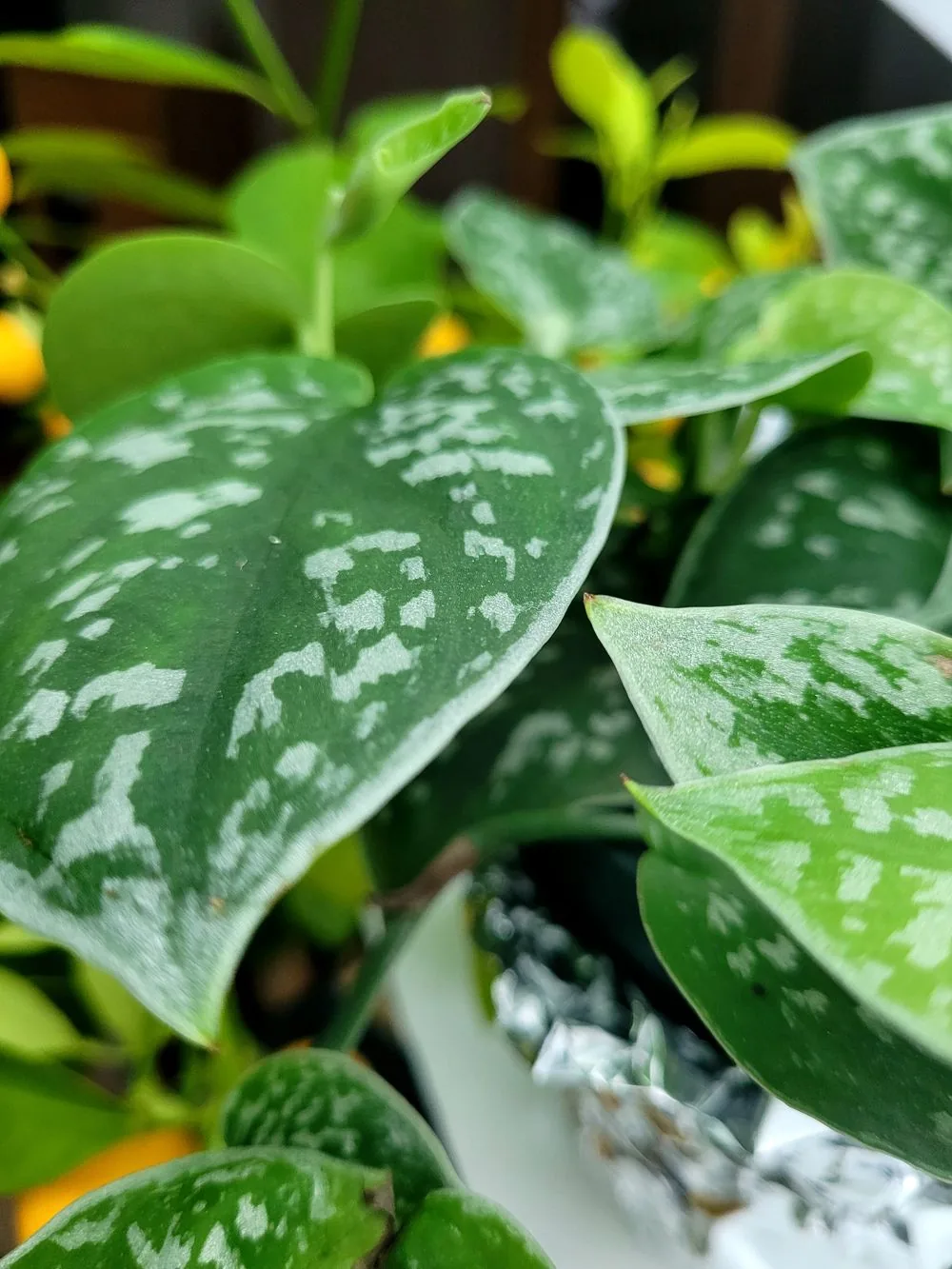
Satin Pothos is the trailing aroid prized for its velvety, heart-shaped leaves, each splashed with an irregular silver-grey pattern that genuinely shimmers when light catches the leaf surface. Despite its common name and close resemblance to true pothos, it belongs to a different genus, Scindapsus, and the two are easy to tell apart once you know the texture: this plant's leaves are matte and slightly quilted rather than the glossy smoothness of Epipremnum aureum. Left to trail it can reach well over a metre, and it climbs readily up a moss pole if one is given.
Bright, indirect light for the best silver patterning. It tolerates lower light but grows more slowly and with plainer, less patterned leaves.
Water
Let the top 3-4cm of compost dry before watering again, then water thoroughly. It is more drought-tolerant than many aroids and dislikes sitting in wet compost.
Humidity
Average household humidity is generally fine; higher humidity encourages larger, glossier leaves but is not essential the way it is for some rainforest aroids.
Soil
A free-draining, chunky mix, similar to what a pothos or philodendron needs. Standard dense potting compost holds too much water around the roots.
Temperature
18-29°C, away from cold draughts.
Size
45-90cm indoors.
Growth speed
Slow
!Toxic to pets
Toxic to cats and dogs if eaten.
Chewing it can irritate the mouth, causing drooling and trouble swallowing.
If your pet has eaten some, contact your vet.
Source: ASPCA
Signature feature
The silver patterning is not pigment sitting on top of the leaf but air pockets within the leaf tissue itself, which scatter light differently from the solid green around them. This is why the pattern looks almost metallic and shifts subtly as you move around the plant or change the angle of the light, an effect ordinary printed or painted variegation cannot produce.
Care by Season
Spring
Growth resumes; a good time to repot a rootbound plant or start training new growth up a support.
Summer
Main growing season. Water and feed regularly, and pinch growing tips occasionally to encourage a bushier, fuller plant rather than a few long bare stems.
Autumn
Growth slows as light drops; reduce watering frequency to match the slower uptake.
Winter
Rest period. Water only once the compost has dried well through, and keep it away from cold draughts, which it dislikes.
Growing & Maintenance
Soil and pot
A free-draining, chunky mix, as for a pothos or philodendron, in a pot with drainage holes.
Repotting
In spring, once the plant is root-bound.
Fertilising
Feed regularly through the main growing season in summer. None in winter.
Pruning
Pinch the growing tips now and then to make the plant bushier.
Support
It can trail from a shelf or climb a moss pole. On a support the leaves grow larger.
Propagation
From stem cuttings with at least one node.
Pests & Diseases
Common problems
Curling leaves
Most likely cause: The compost has dried out too far.
What to do: Water thoroughly. The leaves flatten again within a day or two.
Yellow leaves
Most likely cause: Overwatering.
What to do: Let the top 3-4cm of compost dry before watering again.
New leaves plain green
Most likely cause: Too little light.
What to do: Move it to bright, indirect light.
Brown, crispy patches
Most likely cause: Direct sun.
What to do: Give it bright light without direct sun.
Long stems with few leaves
Most likely cause: Low light, and no pinching.
What to do: Pinch the growing tips and give it more light.
Pests & Diseases
Mealybugs
Signs: Small, white, cottony clusters in leaf joints and along stems, often with a sticky residue on nearby leaves.
Treatment: Dab visible bugs with a cotton swab dipped in rubbing alcohol, then treat the whole plant with an insecticidal soap, repeating weekly until none remain. Isolate an affected plant from others while treating it. Check the undersides of the leaves and the crevices where the leaf stem meets the main stalk.
Root rot
Signs: Yellowing lower leaves, a mushy stem base, and compost that stays wet far longer than expected.
Treatment: Caused almost always by overwatering or poor drainage. Let the compost dry out fully, and repot into fresh, free-draining mix if the roots are visibly black or mushy.
Scale insects
Signs: Small brown bumps on the stems and the undersides of the leaves
Treatment: Scrape them off gently and treat the plant with insecticidal soap.
FAQ
My Satin Pothos has lost its silver patterning and the new leaves are coming in plain green. Why?
Almost always too little light. The silver patterning is a light-related trait, and a plant moved somewhere dimmer than it needs often produces progressively plainer leaves as it prioritises chlorophyll-rich green tissue for photosynthesis over the patterned, less efficient areas. Moving it to a brighter spot with good indirect light usually restores strong patterning in new growth within a few leaves, though already-plain leaves will not change back.
Should I let it trail or train it up a support?
Either works, and the choice changes the leaf size rather than the plant's health. Left to trail, leaves stay relatively small and the plant produces long, cascading stems well suited to a shelf or hanging basket. Given a moss pole or similar support to climb, it produces noticeably larger, more mature-looking leaves as it grows upward, since climbing aroids generally size up once they have something to attach to.
Is the Satin Pothos toxic to cats and dogs?
Yes, the Satin Pothos is toxic to cats and dogs. Chewing it irritates the mouth, so keep it out of reach of pets.
How often should I water a Satin Pothos?
When the top 3-4cm of compost has dried, then water thoroughly. Curling leaves are a sign that it has waited too long.
How do I propagate a Satin Pothos?
From stem cuttings. Take a piece with at least one node and root it in water or moist mix.
How fast does a Satin Pothos grow?
Slowly. Indoors it usually reaches 45-90cm, and it grows even more slowly in low light.