No results. Is a plant missing? Tell uscontact@wikiplant.net
Scots pine
Pinus sylvestris
Care level: Easy
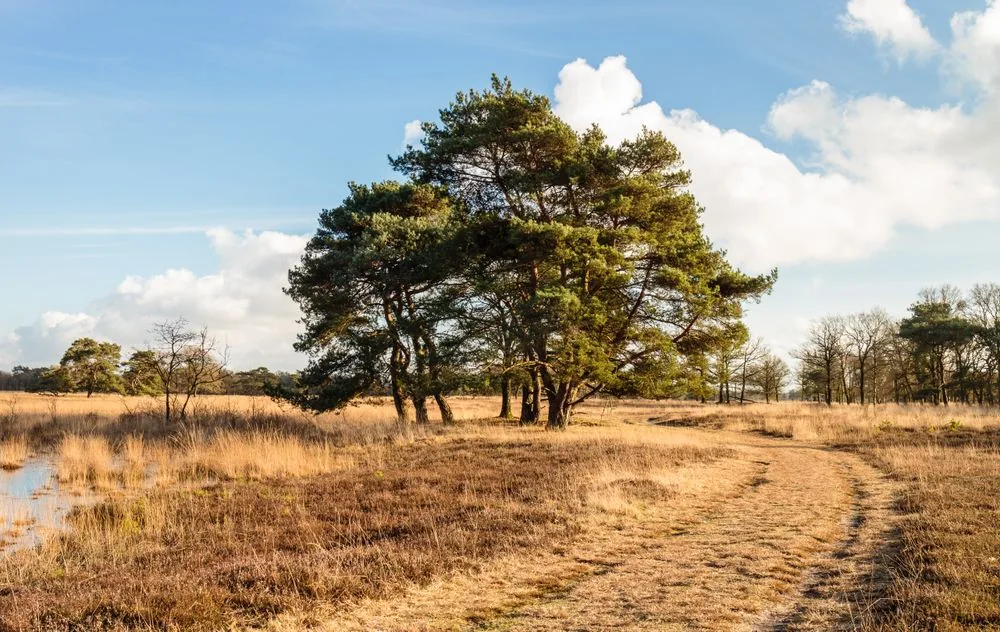
The Scots pine is the most widespread pine in the world, native from Scotland and Spain to eastern Siberia. A young tree is a neat cone; with age it loses its lower branches and develops a tall, bare trunk and a flat or rounded, irregular crown. Its two best features are the bark, which flakes to a warm orange-brown on the upper trunk and branches, and the short, twisted, blue-green needles held in pairs. It grows in any well-drained soil in full sun, including poor, sandy and acid ground, and withstands cold and wind.
As a precaution, keep it out of reach of children and pets.
Signature feature
Look up to recognise it. No other common European conifer has that orange-brown, papery bark in the upper crown, glowing in low sun above a grey, plated lower trunk.
Care by Season
Spring
New shoots, the candles, lengthen and pollen is shed in late spring.
Summer
Growth hardens. Water young trees in drought.
Autumn
The oldest needles yellow and fall. Planting time begins.
Winter
The tree is dormant and fully hardy. Plant and stake young trees.
Growing & Maintenance
Planting
Plant young, container-grown trees between autumn and spring in full sun, with room for a wide crown, and stake for the first two years. Small trees establish far better than large ones.
Pruning
No pruning is needed. Remove dead or awkward branches cleanly at the trunk in winter and never cut back into bare wood.
Propagation
By seed sown in spring. Named forms are grafted.
Pests & Diseases
Common problems
Old inner needles yellow in autumn
Most likely cause: Natural needle drop.
What to do: Nothing to do.
Whole branches brown from the base up
Most likely cause: Shade, or waterlogged roots.
What to do: Remove dead branches and improve drainage.
Bare patches after pruning
Most likely cause: Cuts made into leafless wood.
What to do: They will not fill in; prune only green growth.
A young tree leans or rocks
Most likely cause: Wind before the roots have anchored.
What to do: Stake low down for two years.
Thin, sparse crown
Most likely cause: Too little light or compacted, wet soil.
What to do: Clear competing growth and keep the root area open.
Pests & Diseases
Pine adelgid
Signs: Tufts of white, waxy wool on the bark and at the base of the needles in spring and summer.
Treatment: It looks unsightly but rarely harms the tree; no treatment is needed.
Conifer aphids
Signs: Large brown or grey aphids on the shoots, with sticky honeydew and black sooty mould.
Treatment: No treatment is needed on a garden tree; predators follow.
Pine sawfly larvae
Signs: Groups of pale green caterpillar-like larvae stripping the needles from a shoot in summer.
Treatment: Pick or knock them off a young tree. Older needles are eaten but the buds survive.
Needle cast
Signs: Needles spotted yellow then brown, falling early, mostly on the lower branches in damp, still sites.
Treatment: Rake up fallen needles and open up the site to air and light.
Pine shoot moth
Signs: Shoot tips that bend, ooze resin and die, leaving a kinked or forked leader.
Treatment: Cut out affected shoots on a young tree.
FAQ
How fast and how big does a Scots pine grow?
Quickly when young, often 30-50cm a year, slowing with age. It reaches 25m or more in time with a wide crown, so it is a tree for a large garden, a boundary or a shelter belt.
Can I prune it or keep it small?
It needs no pruning, and it cannot be cut back hard: pines do not regrow from bare, leafless wood. You can remove whole lower branches at the trunk, and shorten the soft new shoots, the candles, by half in late spring to keep growth denser.
Why are the inner needles turning yellow and falling in autumn?
That is normal. Pines shed their oldest needles, those two to three years old, each autumn. Browning at the shoot tips or on the current year's needles is the sign of a problem.
What soil does it need?
Any soil that drains. It is at home on dry sand and thin, acid soils where little else thrives. It dislikes waterlogged ground and deep shade.
Is it a good tree for wildlife?
Yes. The seeds feed crossbills, siskins and red squirrels, the bark shelters insects and old trees carry nests of birds of prey.
Can I plant my potted Christmas pine outside?
Yes, if it was sold with its roots in a pot. Get it used to the cold gradually, plant it in sun and water it through its first summer.