No results. Is a plant missing? Tell uscontact@wikiplant.net
Shrimp Plant
Justicia brandegeeana
Care level: Easy
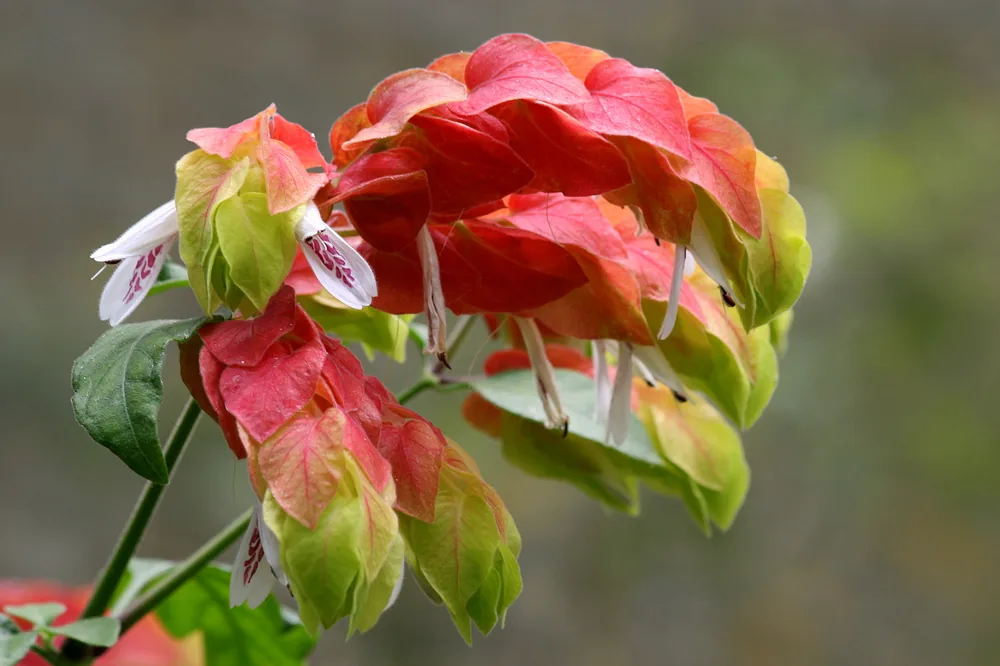
Justicia brandegeeana takes its common name from the overlapping, curved bronze-pink bracts that stack up its flower spikes, giving each one a startlingly convincing resemblance to a cooked shrimp. The true flowers are the small white tubular blooms that peek out from between the bracts, and a healthy plant can produce them almost continuously.
Bright light with some direct sun encourages the best flowering; tolerates medium light but blooms less.
Water
Keep soil lightly moist, watering when the top 2-3cm dries, roughly every 5-7 days; avoid letting it dry out completely for long.
Humidity
Prefers moderate humidity but adapts reasonably well to average indoor air.
Soil
Rich, well-draining potting mix.
Best position
east / south-east / south / west-facing windowanywhere up to about 2 m from the window
north / north-east / north-west-facing windowanywhere up to about 1 m from the window
south-west-facing windowabout 1 m from the window or further back
Watch for strong direct sun at south-west windows.
See every window directionHide window directions
Best position
right by the window
about 1 m
about 2 m
about 4 m
4 m or more
north
works well✓
works well✓
too dark○
too dark○
too dark○
north-east
works well✓
works well✓
too dark○
too dark○
too dark○
east
works well✓
works well✓
works well✓
too dark○
too dark○
south-east
works well✓
works well✓
works well✓
too dark○
too dark○
south
works well✓
works well✓
works well✓
too dark○
too dark○
south-west
just about~
works well✓
works well✓
too dark○
too dark○
west
works well✓
works well✓
works well✓
too dark○
too dark○
north-west
works well✓
works well✓
too dark○
too dark○
too dark○
✓works well~just about○too dark☼too much direct sun
A rough guide based on window direction and typical daylight through the year. Window size, curtains and whatever stands outside matter just as much.
?Pet safety not confirmed
As a precaution, keep it out of reach of children and pets.
Did you know?
The colorful "shrimp" part of the plant is made of bracts, modified leaves, not petals; the actual flowers are the small white tubes that emerge from between them, similar to how a poinsettia's red "petals" are really bracts too.
Care by Season
Spring
Prune lightly to encourage bushy growth and resume regular feeding as new shoots appear.
Summer
Water consistently and enjoy near-continuous flowering in good light.
Autumn
Reduce feeding and slightly ease off watering as growth slows.
Winter
Water a little less, keep in the brightest available spot, and expect fewer blooms until spring.
Growing & Maintenance
Soil and pot
A rich, well-draining potting mix in a pot with drainage holes.
Fertilising
Feed regularly from spring through summer, as new shoots appear. Reduce in autumn.
Pruning
Prune lightly in spring and after each flush of flowers to keep it bushy.
Propagation
From stem cuttings.
Pests & Diseases
Common problems
No flowers
Most likely cause: Too little light.
What to do: Move it to a spot with a few hours of direct sun.
Leggy, bare at the base
Most likely cause: No pruning.
What to do: Prune lightly after each flush of flowers to make it branch.
Leaves dropping
Most likely cause: The compost has dried out completely.
What to do: Keep the compost lightly moist and water when the top 2-3cm has dried.
Yellow leaves
Most likely cause: Soggy compost.
What to do: Let the top 2-3cm dry before watering and make sure the pot drains.
Sticky leaves and tiny insects on the shoot tips
Most likely cause: Aphids or whitefly.
What to do: Rinse them off with water and treat with insecticidal soap.
Pests & Diseases
Aphids
Signs: Small insects clustering on new growth and flower bracts
Treatment: Rinse off with water or apply insecticidal soap.
Whitefly
Signs: Tiny white flying insects that scatter when the plant is disturbed
Treatment: Use yellow sticky traps and treat with insecticidal soap.
Spider mites
Signs: Fine webbing and stippled leaves in dry indoor air
Treatment: Raise humidity and rinse foliage regularly. Check the undersides of the leaves and the crevices where the leaf stem meets the main stalk.
FAQ
Why has my Shrimp Plant stopped flowering?
Flowering is closely tied to light; move it to a spot with a few hours of direct sun rather than just bright indirect light, since plants kept in medium light tend to grow green and healthy but bloom far less.
Why is my Shrimp Plant getting leggy and sparse at the base?
Regular light pruning after flowering flushes encourages branching; an unpruned Shrimp Plant naturally grows tall and thin with bare lower stems over time.
How often should I water a Shrimp Plant?
Roughly every 5-7 days, when the top 2-3cm of compost has dried. Keep it lightly moist and water a little less in winter.
How much light does a Shrimp Plant need?
It needs bright light with some direct sun. It tolerates medium light but then flowers much less.
How do I propagate a Shrimp Plant?
From stem cuttings. The pieces you remove when pruning can be used as cuttings.
What are the coloured 'shrimps' on a Shrimp Plant?
They are bracts, which are modified leaves, not petals. The true flowers are the small ones that peek out between them.