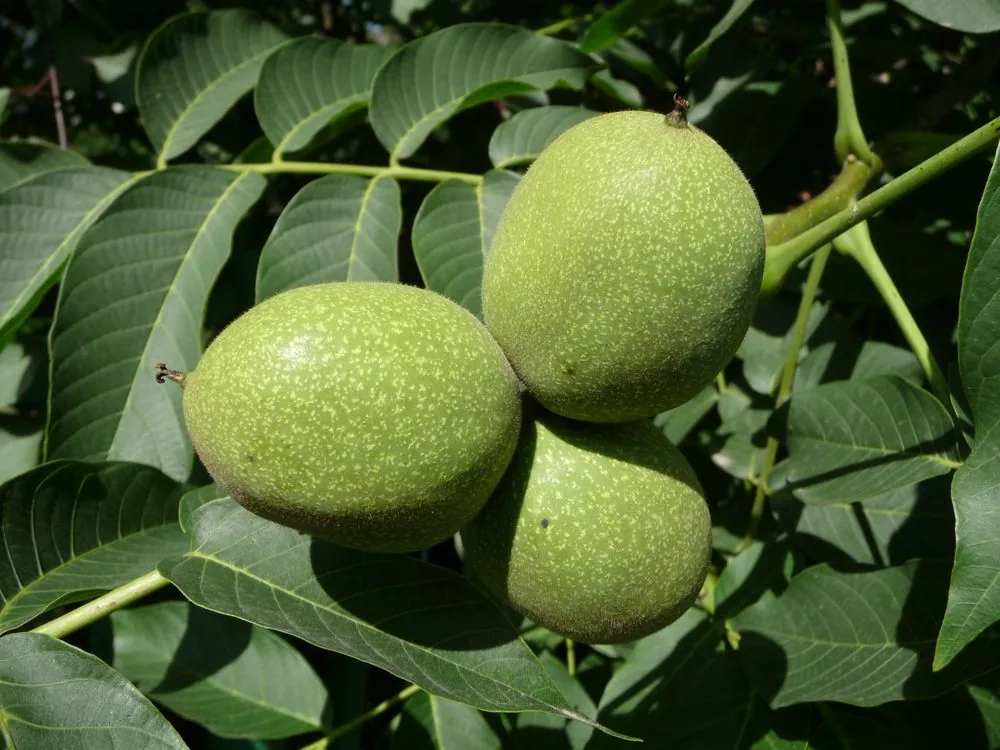
Three round green unripe walnuts in their husks among large leaves on the tree

Walnut

Juglans regia
Care level: Easy

The common walnut is a large, long-lived, broad-crowned deciduous tree, grown for its nuts and as a handsome shade tree. It has smooth, silver-grey bark that becomes furrowed with age and big leaves made up of five to seven oval leaflets, which smell sharply aromatic when crushed. Male catkins and tiny female flowers open in late spring, and the nuts ripen in autumn inside a thick green husk that splits to release them. It comes into leaf late, tolerates most soils and needs a great deal of room: this is a tree for a large garden, orchard or field.

I have this plant

Information

Varieties and related species
Juglans regia 'Broadview'Juglans regia 'Franquette'Juglans nigra

Light

Full sun, in an open position with room for a wide crown.

Water

Water young trees in dry spells for the first few years. Established trees need no watering.

Humidity

Not a factor for this outdoor tree.

Soil

Deep, fertile, well-drained or moist but well-drained soil. It tolerates most soil types, including chalk, but not waterlogging.

Size

12-20m tall and 8-15m wide.

Growth speed

Medium

Hardiness

Hardy down to about -20°C. Source: RHS

Pet safety not confirmed

As a precaution, keep it out of reach of children and pets.

Common mistake

Prune only between midsummer and early autumn. A walnut cut in late winter or spring bleeds sap heavily from the wounds for weeks, which weakens it. It needs very little pruning in any case: remove dead, damaged and crossing branches and leave the rest.

Care by Season

Spring

Leaves and catkins appear late in spring. Protect young trees from late frost where possible.

Summer

The nuts swell. Do any pruning from midsummer. Green nuts for pickling are picked in early summer, before the shell hardens.

Autumn

The husks split and the nuts fall. Gather, clean and dry them. Rake up fallen leaves.

Winter

Dormant. Plant new trees but do not prune.

Growing & Maintenance

Planting

Plant young trees between late autumn and early spring, in their final position, as walnuts form a deep taproot and dislike being moved. Stake for the first two or three years.

Fertilising

Mulch young trees with garden compost in spring. Established trees need no feeding.

Pruning

Prune between midsummer and early autumn only, and as little as possible. Remove dead, damaged and crossing branches.

Propagation

Named varieties are grafted. Nuts sown fresh in autumn germinate in spring, but the seedlings are slow to crop and variable.

Pests & Diseases

Common problems

Young shoots blackened

Most likely cause: Late spring frost.
What to do: Wait for regrowth and choose late-leafing varieties in frosty areas.

No nuts

Most likely cause: A tree still too young, frost on the flowers or poor pollination.
What to do: Be patient, and plant a second tree or a self-fertile variety.

Sap pouring from cuts

Most likely cause: Pruning in late winter or spring.
What to do: Prune only from midsummer to early autumn.

Empty or shrivelled kernels

Most likely cause: Poor pollination or summer drought.
What to do: Water young trees in dry summers; a pollination partner helps.

Black, rotting husks

Most likely cause: Leaf blotch in a wet season.
What to do: Clear fallen leaves and nuts.

Plants nearby fail

Most likely cause: Shade, dry soil and juglone from the walnut.
What to do: Grow sensitive plants such as tomatoes well away from the tree.

Pests & Diseases

Walnut blister mite

Signs: Raised, glossy blisters on the upper surface of the leaves, with pale, felt-like patches underneath.
Treatment: No action needed. The damage looks odd but does not harm the tree or the crop.

Walnut leaf blotch

Signs: Brown blotches on the leaves and black, sunken patches on the green husks; young nuts may blacken and fall in wet summers.
Treatment: Rake up and dispose of fallen leaves and affected nuts in autumn.

Aphids

Signs: Small yellowish insects along the leaf veins, with sticky honeydew on the leaves below.
Treatment: No treatment is practical or needed on a tree; predators keep them in check.

Squirrels

Signs: Nuts taken from the tree before they ripen, with gnawed husks on the ground.
Treatment: Collect fallen nuts promptly. Protection is rarely possible on a large tree.

FAQ

How long before a walnut tree gives nuts?

A grafted, named variety usually starts within four to six years of planting. A tree grown from a nut can take ten to twenty years, and the quality of its nuts is unpredictable.

Do I need two trees?

One tree carries both male catkins and female flowers, but they often open at different times, so pollination by its own pollen is unreliable. The wind carries pollen a long way, and a second walnut nearby improves the crop. Some varieties, such as 'Broadview', are self-fertile.

When and how do I harvest the nuts?

In autumn, when the green husks split and the nuts fall. Gather them every day or two, pull off the remains of the husk, brush the shells clean and dry the nuts in a single layer in an airy place. Wear gloves: the husks stain skin dark brown for days.

Why are the young shoots black in spring?

Late frost. The new shoots, catkins and flowers are tender, and a frost after growth starts kills them back and costs that year's crop. The tree reshoots. Avoid frost pockets and choose a variety that comes into leaf late.

Can I grow other plants under a walnut?

It is difficult. The dense crown casts heavy shade, the roots dry the soil, and the tree releases a substance called juglone that stunts some plants growing near it, notably tomatoes, potatoes and apple trees. Grass and spring bulbs usually cope.

Is it suitable for a small garden?

No. Even the more compact grafted varieties become substantial trees, and a seedling walnut can exceed 20m with a crown just as wide. Plant it well away from buildings and boundaries.

Who is taking the nuts?

Squirrels, mostly, along with crows and other birds, often before the nuts are ripe. On a large tree there is little you can do except collect fallen nuts promptly.

You might also like